Modern application development workflows are evolving rapidly, with developers adopting rapid methodologies to ship code more quickly. Yet, after so many years, the application security process remains a challenge for the teams with its slow and fragmented process. In AppSec, Dynamic Application Security Testing or DAST serves as the final security process that is used for simulating real-world threats on the running application to identify.
Despite being a powerful AppSec tool, it is slow, resource-hungry, generates huge false positives, and offers vague remediation suggestions. But modern development approaches don’t have time for such bottlenecks.
This is where QINA Pulse comes to the rescue. It is a powerful AI security assistant that helps streamlining DAST workflows by moving beyond simple scanning and remediation. This guide highlights how QINA Pulse initiates automated DAST scans and streamlines the workflow.
The Core Issues with DAST in Modern Development Approach
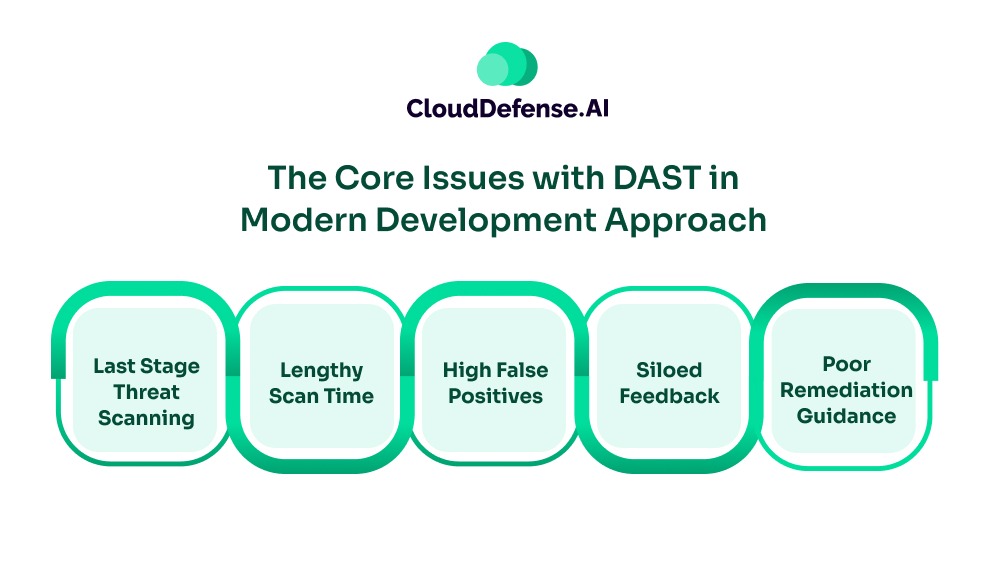
While DAST utilizes a black box testing approach to help enterprises in identifying serious threats, the issues with legacy workflow make it difficult to utilize. These issues are:
- Last Stage Threat Scanning: In a standard AppSec strategy, DAST scans are mostly implemented in the last stage for scanning in SDLC. When a DAST finds a vulnerability, the flawed code is usually merged and built. This not only increases the time to remediate the threat and hampers deployment velocity but also makes it costly to remediate.
- Lengthy Scan Time: Usually, when traditional DAST scans are triggered at the end, it takes hours to complete. The completion time depends largely on the complexity of the application infrastructure. Such a lengthy scan time puts a halt to the continuous delivery process and leads to a slow development approach. Importantly, development wastes a lot of valuable time waiting for the result to appear.
- High False Positives: DAST tools have evolved with time, but it still generates a huge volume of alerts, a good percentage of which are false positives. The lack of context or dependency of preset rules causes it to flag most issues. Teams have to spend hours triaging the security findings, leading to alert fatigue. Moreover, it diverts teams from performing high-value work and also leads them to miss many critical threats.
- Siloed Feedback: In most cases, DAST results are provided to developers or security teams in PDF reports. Furthermore, these reports lack detailed insight into the vulnerabilities and the actual context. This siloed feedback leads to friction between the AppSec team and developers, causing teams to overlook vulnerabilities. Importantly, the security and development team doesn’t share a real-time dashboard where they can communicate for security alerts, and depends upon tickets.
- Poor Remediation Guidance: Despite modern DAST tools having high accuracy in identifying vulnerabilities, the areas they lack are offering actionable threat fixes. In most instances, developers and security professionals only get reports with identified threats and severity scores. They don’t usually come with remediation guidance. Even if they do, they lack contextual guidance specific to the vulnerable code.
QINA Pulse: Intelligent Orchestration Tool for Streamlining DAST
QINA Pulse isn’t just another security tool to integrate into the development environment; rather a powerful AI-powered security assistant to streamline all DAST tasks. It is a context-aware security co-pilot that sits in the AppSec stack to work as an orchestration layer. It unifies all the security tools like SAST, DAST, SCA, and others into a single security chatops that all the teams can utilize collaboratively in real time.
Pulse is built on AI and ML that prioritizes context-aware dynamic application security testing automation. It is a vital tool for streamlining DAST workflow as it enables teams to trigger automated DAST, triage the findings, and remediate them without leaving their workflow.
How QINA Pulse Helps with Automated DAST and Streamlines the Workflow?
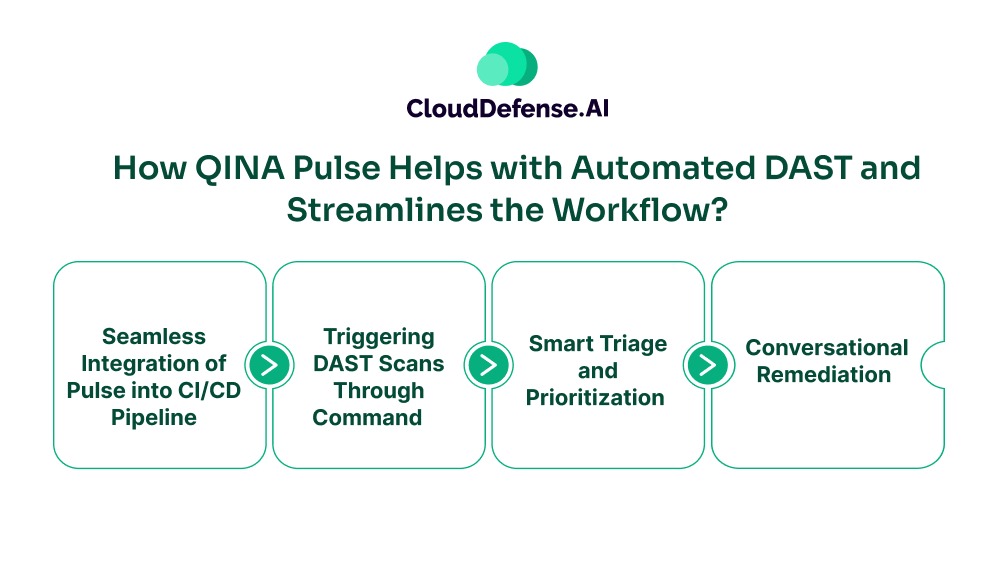
Now, it boils down to the question of how an enterprise can use QINA Pulse to trigger automated DAST and streamline the workflow. To streamline the DAST workflow, the organization requires a strategic approach to seamlessly integrate with existing DAST tools and automate the workflow.
Here is a detailed guide to utilize Pulse for DAST pipeline integration and automation:
Seamless Integration of Pulse into CI/CD Pipeline
The main aim of enterprises is to make DAST streamlined and automated for the teams. QINA Pulse helps teams to achieve it by beginning the process through direct integration into the CI/CD pipeline and IDE. Pulse has been designed meticulously to integrate natively with 50+ enterprise tools.
Whether an organization is using Jira, Jenkins, Slack, or GitLab, it integrates seamlessly with these tools without requiring any complex configuration. During integration, Pulse can be configured with pipeline gates to trigger different functions. In some cases, environment provisioning can also be established during integration.
Triggering DAST Scans Through Command
A distinctive feature of QINA Pulse is that it enables teams to trigger and automate DAST scans through simple English language. Developers won’t have to switch the dashboard, as Pulse enables them to put commands in English from the development environment.
Most importantly, teams can also implement automated DAST scans through commands to trigger them during various stages. A standard continuous scan can be initiated during a pull request, while a deep DAST scan can be initiated before deployment. Through commands, developers and analysts can automate continuous scans that will help in identifying flawed code after it has been committed.
Pulse, through its simple English command capability eliminates all the complexity. It enables teams to configure and initiate multiple scans without needing to master the art of different syntax. Thus, Pulse enables teams to utilize DAST in their workflow rather than considering it as a separate security afterthought.
Smart Triage and Prioritization
A major characteristic of Pulse that plays a significant role in streamlining DAST workflow is smart triaging and prioritization. The security co-pilot utilizes ML and AI to perform automated triage on all the security findings from DAST scans and provide a smartly prioritized report.
A DAST scan generates a huge number of alerts, but Pulse utilizes AI and ML to intelligently analyse the report. The security assistant performs reachability analysis and deduplication to prioritize the security findings. It also utilizes contextual analysis based on business logic, the developer’s intent, and application architecture.
During prioritization, Pulse doesn’t only consider the CVSS score but also considers exploitability and existing security policies of the organization. It also correlates findings from live threat data streams, SAST data, and other security tools. This not only helps in eliminating all the false positives from the reports but also provides a contextualised DAST scan report. It helps teams to quickly focus on threats that require immediate response before the application is finally deployed.
Conversational Remediation
QINA Pulse also offers conversational remediation, where teams can automate remediation of threats, which ultimately aids in streamlining DAST workflow. Each report comes with contextual remediation guidance, which assists teams in quickly patching the flaws before the application goes live. QINA Pulse not only provides contextual guidance for each vulnerability but also code snippets for easy access.
Teams can just command the security assistant to execute the advised remediation process. Pulse can be commanded and configured by developers to automate the remediation process for specific types of vulnerabilities. This automated DAST process will be highly useful to streamline the DAST workflow and bring complete automation.
Strategic Benefits QINA Pulse Brings By Streamlining DAST Workflows
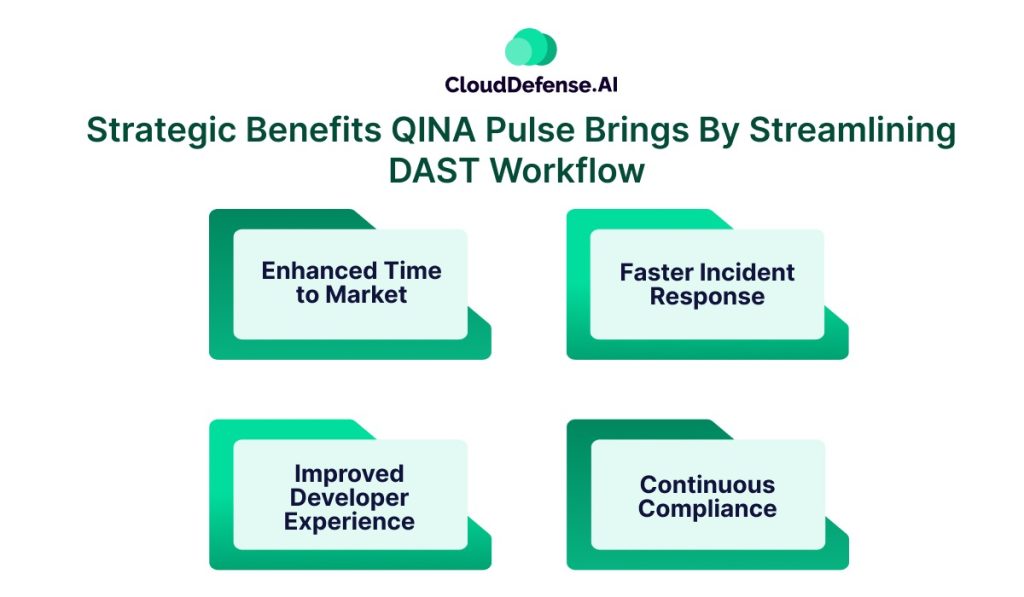
When an enterprise moves from standard DAST workflow to automated DAST through QINA Pulse, it benefits them in many ways:
- Enhanced Time to Market: By implementing Pulse to streamline DAST workflow, teams can eliminate all security bottlenecks and achieve faster time-to-market. Since Pulse automates the triage and remediation of all DAST findings, it enables developers to work smoothly on their development tasks.
- Faster Incident Response: Incident response is a huge issue in the legacy DAST workflow. However, an automated DAST through Pulse helps the team to focus on actual threats and remediate them before the application is deployed. It also enables teams to automate the remediation for specific groups of threats.
- Improved Developer Experience: Pulse through a unified dashboard allows developers and security professionals to work collaboratively for the DAST workflow. Furthermore, it significantly reduces false positives and improves MTTR. It ultimately aids a better experience among developers and facilitates collaboration between teams.
- Continuous Compliance: For almost every enterprise, maintaining adherence to strict regulatory requirements is a top priority. Whether it is PCI DSS, SOC, HIPAA, or GDPR, every standard has its specific set of requirements. By streamlining DAST workflow, Pulse helps organizations to maintain compliance and generate audit-ready reports on demand. Pulse continuously aggregates all the threat data and maps the findings to regulatory controls.
Bottom Line
An automated DAST has become a need of the hour as enterprises move towards faster DevSecOps to cope with modern cybersecurity. With time, applications are getting more complex, and simplifying DAST workflow has become vital to eliminate threats reaching the deployment stage. QINA Pulse, through its advanced AI approach and contextual remediation, streamlines the DAST workflow significantly.
By providing a unified dashboard and conversational AI, it enables teams to move beyond Shift-left and implement the Shift Smart approach. It enables the team to focus on strategic tasks while Pulse takes care of all the security workflow. Pulse helps modern enterprises to go past the thought of modernizing DAST workflow and helps them focus on improving the SDLC.