In modern DevSecOps, development teams are involving complex microservices and AI code editors. All of this to achieve what? High velocity application deployment. Subsequently, security teams are also scaling their scanning coverage- implementing DAST, SCA, SAST, and other scanning tools across all repositories.
However, the sheer volume of security alerts is creating significant “noise”. Traditional security scanners lack AI support and leverage rigid rules to identify security threats. As a result, it creates a lot of alerts- mostly false positives. Developers have to manually triage all alerts to identify the actual vulnerability. It not only bottlenecks productivity but also causes them to miss critical threats.
To keep pace with modern development approaches, organisations are turning to automated vulnerability triage tools. These tools are highly efficient- they filter out all false positives and provide developers with alerts that matter. This guide will explain how organisations can adopt automated vulnerability triage tools to accelerate security without the issue of false positives.
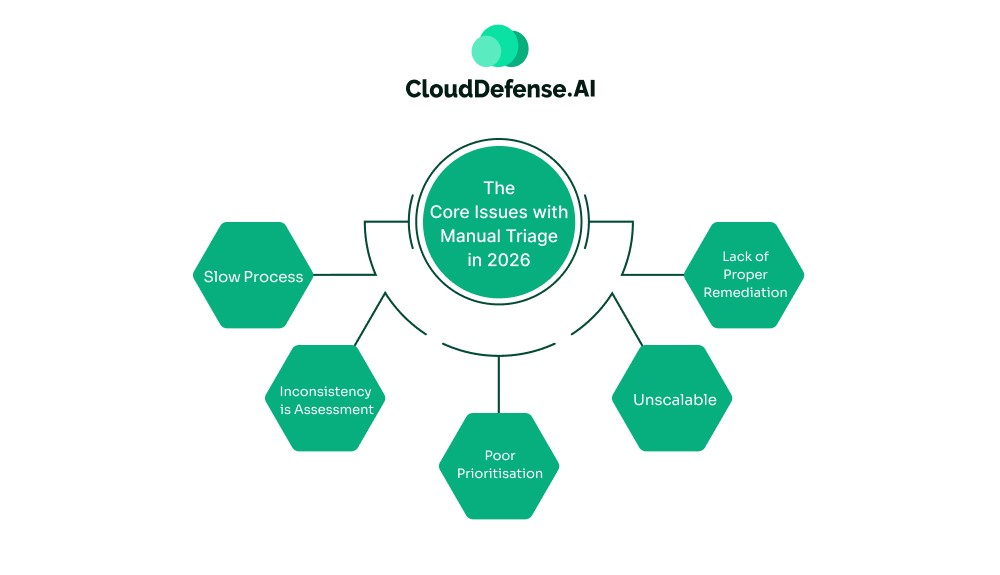
The Core Issues with Manual Triage in 2026
With time, the software supply chain is growing, and organisations are moving towards AI-driven development approaches. The number of alerts is also increasing as cybersecurity involves more libraries and repositories.
As a result, relying on manual triage is no longer an option because:
- Slow Process: The major issue with manual triage is that it takes hours and sometimes days to shift from assessment to remediation. Not only developers, but security teams also have to get involved in reviewing every line of flagged code. A lot of alerts generated by standard scanners tend to be false positives. It ultimately creates a high alert fatigue among all the developers.
- Inconsistency is Assessment: Not all security analysts have similar assessment or judgment quality. Moreover, most developers have sound knowledge of cybersecurity. In many cases, it leads to missed security threats or wastage of time on low-impact security threats. It makes the whole process error-prone and hampers the security posture of the application.
- Poor Prioritisation: Another critical problem associated with manual triage is poor prioritization. Standard security scanning tools leverage generic CVSS scores and other security databases to prioritize any security alerts. They don’t assess alerts based on the context, whether the code is dead or reachable in the production environment. This lack of context leads to poor prioritisation of security alerts, causing developers to triage alerts with dead code.
- Unscalable: The codebase for modern applications is growing with time. Developers are utilizing AI code editors to increase the deployment speed. Thus, the number of alerts is also increasing. It is becoming almost impossible for organizations to cope with the increasing need to manually triage all the alerts without compromising application security.
- Lack of Proper Remediation: Most security alerts or tickets generated by security scanners lack any remediation guidance. The alerts only mention security issues and provide a generic solution for the threats. This makes manual triage a difficult task as developers have to look for the ideal solution to remediate the threat. Moreover, the remediation suggestions that come within the alerts are not always appropriate for numerous vulnerabilities speciality zero-day threats.
Automated Vulnerability Triage and Its Benefits
Automated vulnerability triage is the process of using AI, intelligent algorithms, and context-aware analysis to classify, filter, and prioritize security findings. Automated vulnerability triage tools are an automated process that works autonomously without human intervention.
Instead of providing thousands of security alerts to developers, it filters them and decides which are false positives before sending them to the IDE. Basically, it sends alerts for security findings that are reachable, impactful, and require immediate response. AI triage tools are not only about speed; it is more about intelligent prioritisation and providing the right alert to developers.
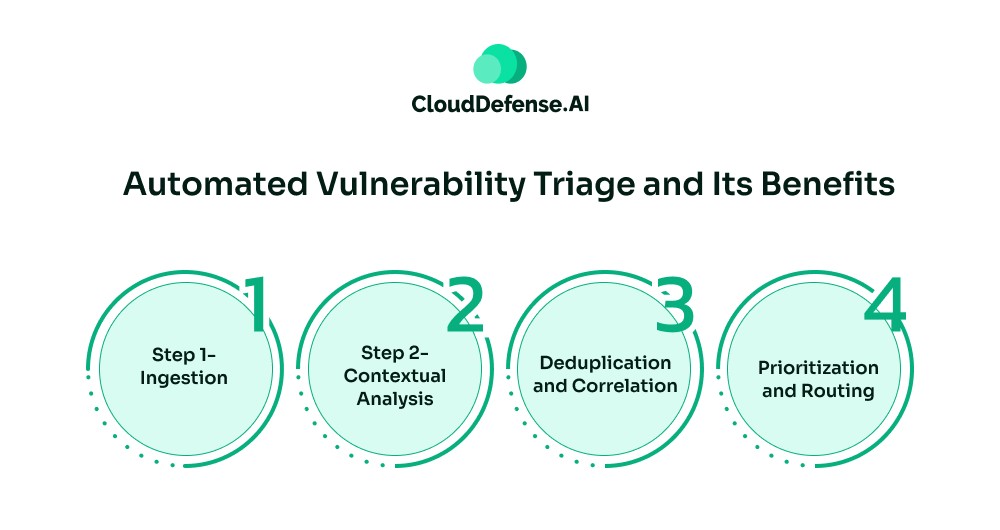
A typical automated vulnerability triage tool involves four critical steps in its workflow for autonomously triaging security findings:
- Step 1- Ingestion: A standard automated vulnerability triage tool ingests all the security data from different security scanning tools. From SAST and DAST to container scanning tools, the tools ingest all their security findings.
- Step 2- Contextual Analysis: These automated tools perform a contextual analysis of all the security findings. It looks at the flagged code and understands whether it will actually make an impact on the application. It evaluates the code based on business and application context.
- Deduplication and Correlation: The tool then merges all the similar security alerts into a single actionable event. It also suppresses those security findings that are vulnerable in nature but won’t cause any impact once the application is deployed.
- Prioritization and Routing: In the end, it just sends alerts in a plain context. The alerts are prioritised according to their impact and routed to the developers. Many AI triage tools even suggest fixes that developers can implement easily.
Key Benefits of the Automated Vulnerability Triage Tool
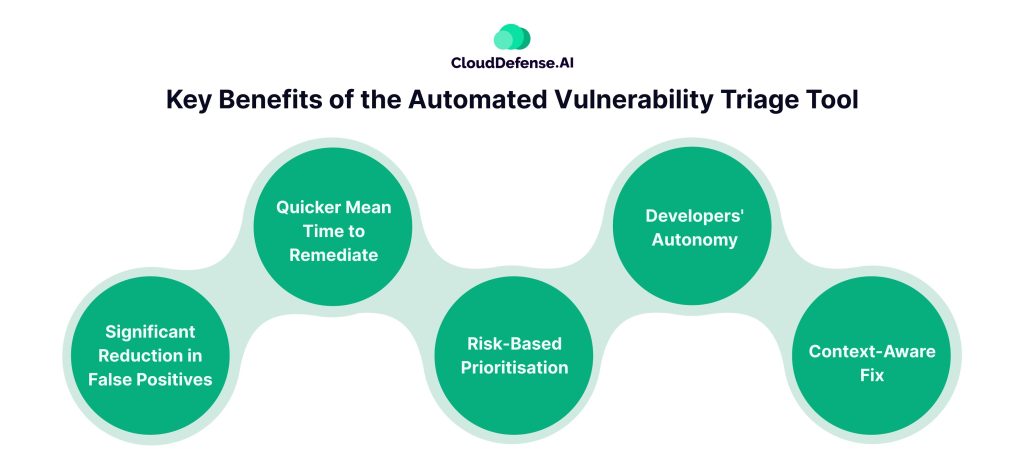
The shift from manual triage to vulnerability triage automation tool benefits the organizations in many ways.
What are these benefits? Here they are:
- Significant Reduction in False Positives: Traditional security scanners generate a lot of security alerts, among which a lot of them are false positives. AI triage tools utilise contextual analysis to filter out all the false alarms. The benefit? Developers won’t have to waste time and can work on the most impactful security alerts.
- Quicker Mean Time to Remediate: In today’s cybersecurity, the MTTR, an organization maintaining, plays a crucial role in their AppSec posture. During manual triage, a critical vulnerability might stay in the queue for days before it is fixed. But automated vulnerability triage solves it by routing critical vulnerabilities with high priority to developers or security teams. It helps the organization in attaining quicker MTTR.
- Risk-Based Prioritisation: Vulnerability triage automation process goes beyond CVSS score, OWASP Top 10, and other vulnerability databases. All the risks are prioritised according to their severity in impact and business context. This helps developers to identify alerts that require a quick fix rather than fixing an issue with low impact.
- Developers’ Autonomy: A major advantage of AI triage tools is that it integrates seamlessly with the IDE and CI/CD pipeline. As a result, all the alerts are posted right into the developers’ environment, preventing frequent context switching. Some modern tools even integrate as a security chatops with NLP. It enables developers to assess and fix vulnerabilities from their workflow.
- Context-Aware Fix: Many modern automated vulnerability triage tools offer users prioritised alerts with context-aware remediation suggestions. It doesn’t contain standard suggestions, but rather a step-by-step guide that developers can easily implement. It offers suggestions based on the application and business context.
QINA Pulse: The Next-Gen Automated Vulnerability Triage Tool
Among all the AI triage tools that organizations are looking to integrate, QINA Pulse has emerged as the most plausible solution. It represents a next-generation tool that acts as a security co-pilot in the developer environment.
This intelligent tool just filters the security findings; it offers a smart and flexible approach to automated vulnerability triage. It leverages AI and ML to intelligently assess all the security findings and prioritise them according to the business and application development context.
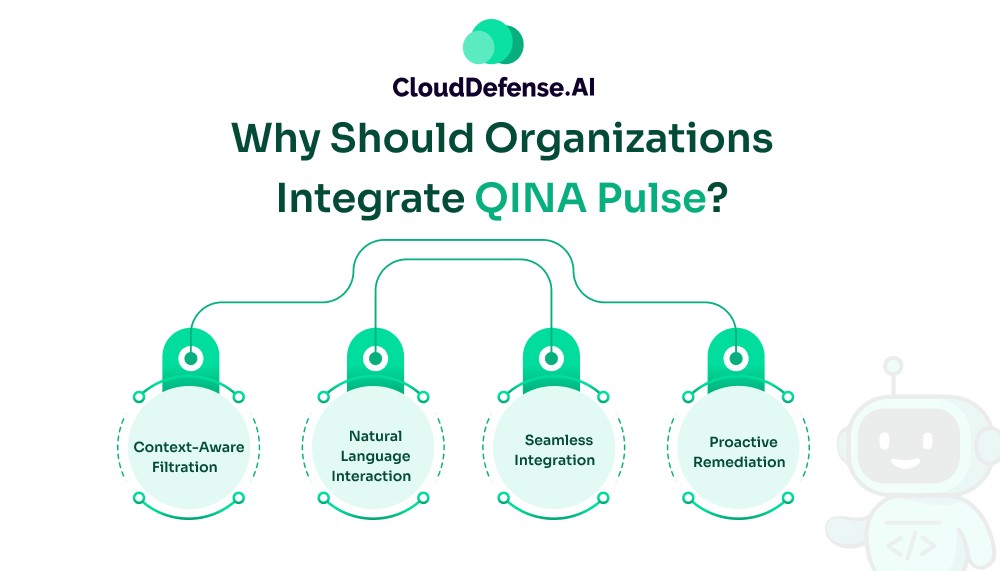
Why Should Organizations Integrate QINA Pulse?
Many organizations are shifting to QINA Pulse for their automated vulnerability triage requirement. But what makes them an ideal solution? It is due to certain Pulse’s key characteristics:
Context-Aware Filtration
QINA Pulse utilizes contextual assessment to filter all the security findings. This AI assistant considers the organization’s business intent, policies, and development workflow for assessment. It utilizes QINA Clarity’s 4-stage analysis to validate the impact of all the flagged codes. During the analysis, dead code extraction, reachability analysis, and predictive analysis are performed to evaluate the impact of the threat.
Natural Language Interaction
One of the major reasons organizations are opting for Pulse is due to its natural language command interface. The security co-pilot enables developers to trigger intelligent triage through a simple command. Developers can interact with them through simple English- democratizing cybersecurity for everyone. It not only prevents frequent dashboard switching but also replaces the need to get acquainted with complex dashboards.
Seamless Integration
QINA Pulse is designed to integrate directly into the development workflow, like Jira and Slack, through a hassle-free process. It ensures the organization requires minimal effort to implement Pulse and start with their vulnerability triage automation task. It ensures the security co-pilot is present throughout the development workflow. Most importantly, all the alerts are delivered directly into tools.
Proactive Remediation
Pulse not only intelligently prioritises all the security alerts for developers but also offers them contextual remediation. It provides guided remediation along with code snippets- enabling developers to easily implement patches to fix the vulnerable code. It helps organizations to proactively address all security threats before they reach the deployment stage.
Conclusion
In the era where thousands of codes are generated daily, automated vulnerability triage tools have become more than a necessity. It has become an essential part of the organization’s AppSec strategy to prioritize alerts and address threats proactively.
The goal of AI triage tools is not to replace human experts; rather empower them. Intelligent solutions like QINA Pulse are enabling organizations to shift from an alert fatigue state to an intelligent and proactive triage approach. It is a smart, intelligent, natively integrated, and conversational tool that enables developers to triage thousands of alerts with ease. Want to know more about how QINA Pulse assists in vulnerability triage? Book a live demo now!