Over the years, artificial intelligence has greatly boosted modern software development. Whether generating code or automating security testing, AI has streamlined SDLC in every manner. But in recent months, the innovation that has been the center of attraction among developers: security chatbots. These chatbots are AI-powered security assistants designed to assist in different application security tasks.
From identifying vulnerabilities to providing remediation guidance, security chatbots for developers ease all security tasks. But with time AI-hype is receding, and many institutions are reconsidering their AI adoption approach.
Importantly, as most developers are drowning in thousands of false positive alerts, they are speculating: Does security chatbots genuinely revolutionise productivity? Or just another sophisticated AI tool that is added to the existing stack?
This article explores how security chatbots for developers helps organization and eliminate all the friction between development speed and security.
What are Security Chatbots?
Security chatbots are AI-backed conversational security assistance that are designed to help developers to accomplish security tasks through simple commands. These security co-pilots integrate seamlessly into IDEs, CI/CD pipelines, and development platforms. The best part? It enables developers to query in natural language.
These developer chatbots are efficient, friendly, and smooth, making it effortless for everyone. Behind these chatbots sit AI, ML, and NLP that interpret commands, understand them, make decisions, and automate them to streamline the security workflow.
Many security assistants also leverage real-time data streams to assess code and identify zero-day vulnerabilities. Unlike traditional assistants, these chatbots are mostly focused on AppSec- scanning code, handling remediation, and managing alert triage.
This helps organizations automate security checks at every stage while maintaining high-speed development. The main aim behind the implementations of these chatbots is to bridge the gap between developers and security analysts.
Productivity Boost: The Reason Organizations Implementing Security Chatbots
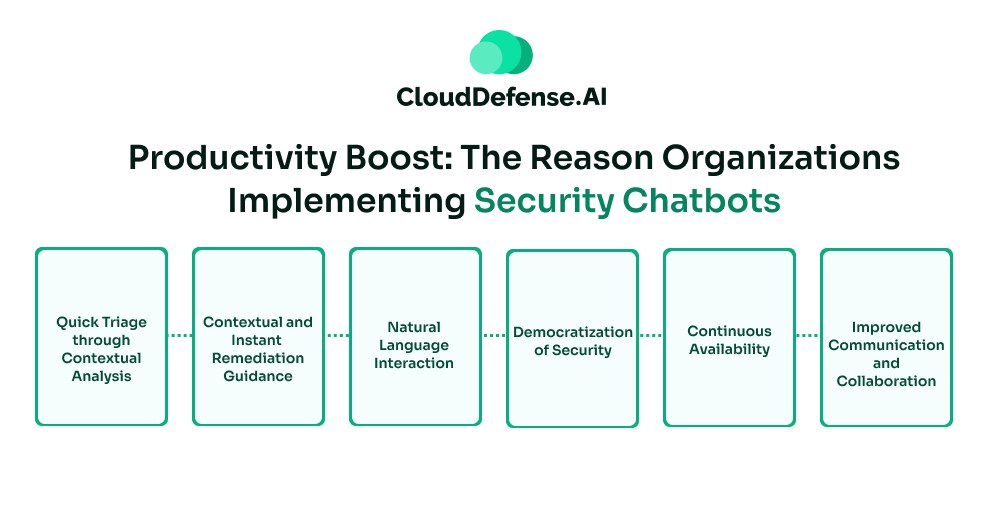
For years, security was considered a bottleneck to application development by developers. The slow security scans, thousands of alerts, and complicated security reports have riddled developers. However, modern security chatbots for developers promise a significant change in how developers handle security.
It is not hype; rather, an advanced tool offering a huge productivity boost. These chatbots benefit developers in many which is why enterprises are implementing them.
- Quick Triage through Contextual Analysis: Gone are those days when developers had to leave their IDE and perform triage on different security alerts. Modern security assistant enables developers to perform all the alert triage tasks through simple commands. Once a developer puts a command, the security agent not only analyses the code but also the entire associated repository, along with business intent. It allows it to understand whether a particular code is vulnerable or not. In the end, the developers get a quick triage output with a detailed and prioritised alert report.
- Contextual and Instant Remediation Guidance: With the integration of security chatbots in the IDE, remediation gets easier for developers. Now, developers won’t have to switch to other dashboards; instead, they have to put commands for remediating any vulnerable code. They just have to command, and the security assistant will provide them with contextual guidance along with code snippets related to that particular vulnerability. Developers can even command the chatbot to automate the remediation process of any particular vulnerability type.
- Natural Language Interaction: Security Chatbots for Developers empower teams to trigger remediation, perform security scans, create tickets, and execute other security actions through simple commands. Built on NLP, these intelligent assistants allow developers to interact in plain English, eliminating complex workflows. By integrating Security Chatbots for Developers into the development lifecycle, organizations can streamline workflows, reduce friction between security and engineering, and accelerate vulnerability identification and remediation.
- Democratization of Security: A highlighting aspect of the security chatbot is that it democratises security for all developers. When a developer puts a command, it replies back with a simple and easy-to-understand contextual report. This enables developers with different security expertise to manage security tasks without requiring additional assistance. It eliminates all the security jargon and delivers reports that can be comprehended by everyone.
- Continuous Availability:Developer chatbots don’t rest; rather, they operate continuously in the IDE, enabling the team with all kinds of security tasks. They are always available in the IDE, making it easy for developers to work with them.
- Improved Communication and Collaboration: All security assistants act as a central communication hub for both development and security teams. Since the chatbot is integrated into the IDE or CI/CD pipeline, it enables the team to make coordinated responses to any issue through a single platform. The chatbots help everyone to keep track of all the security activities. This not only improves the time to respond to security threats but also enhances the overall efficiency while minimizing frequent context switching.
The Reality Check: The Drawbacks of Security Chatbots Requiring Rectification
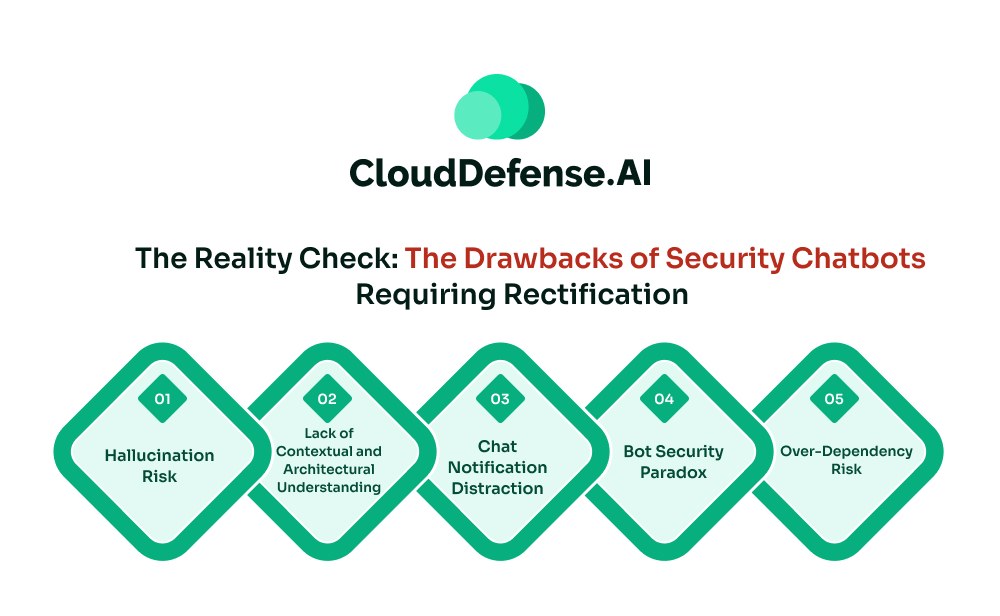
Security chatbots for developers have been a revolution. It assists development as well as security teams in many ways to accomplish security tasks. However, the hype for security chatbots often falls short due to the drawbacks that are yet to be rectified.
The chatbots face issues like:
- Hallucination Risk: It has been seen that a lot of LLM leveraged by developer chatbots faces hallucination risk. A chatbot might suggest a fix for a vulnerability where the package or library doesn’t. In many cases, the package might introduce a new subtle vulnerability or break the build. The hallucination effect cannot only create a backdoor for attackers but also lead to a security breach.
- Lack of Contextual and Architectural Understanding: Application security through chatbot involves an understanding of business logic, code intent, and architectural context. However, many security chatbots act as linters on security scanners, lacking the contextual and architectural understanding. They often struggle with complex and nuanced vulnerabilities that require deep understanding. As a result, the chatbot flags a benign code that ultimately leads to false positives.
- Chat Notification Distraction: Security assistants are integrated into the IDE to improve developers’ productivity. However, security chatbots often break the developer workflow by flooding the IDE with low-priority alerts- causing noise. The overall productivity gets suppressed by digital exhaustion from alerts.
- Bot Security Paradox: A security chatbot during integration gets access to most databases of an organization. However, these security chatbots don’t come with specific guardrails that safeguard from modern threats. An attacker, through prompt injection, can trick a security bot to expose sensitive data or bypass security checks.
- Over-Dependency Risk: Depending too much on security chatbots to accomplish different security tasks might make the security analysts less vigilant. Lack of human oversight might lead to overlooking subtle or zero-day threats that security assistants are unable to identify. Moreover, if the chatbot gets biased with its vulnerability identification, it might cause major damage to the overall security posture.
QINA Pulse: The Next-Generation Security Chatbots for Developers
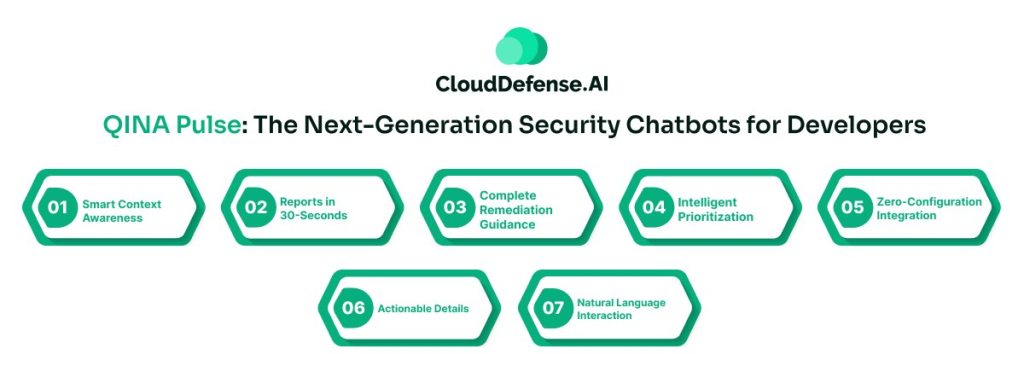
Many security chatbots have been introduced in the industry, offering productivity boosts. However, one security assistant that goes beyond all the hype and delivers genuine productivity is QINA Pulse. It is a next-generation and context-aware AI-powered security chatbot designed specifically to streamline application security.
It acts as a security co-pilot that cuts through all noise by integrating into the IDE or CI/CD pipeline for comprehensive application security. It is one of those purpose-built developer chatbots that is meant to significantly boost productivity in the DevSecOps workflow.
From identifying security flaws, creating tickets, and managing triage to instant remediation guidance, Pulse does it all. It understands the logic and intent behind every code to produce accurate output.
Why QINA Pulse is Favored by Most Developers
QINA Pulse, as an AI-powered security assistant, has become a developer’s unanimous choice. But why QINA Pulse? Let’s find out:
- Smart Context Awareness: QINA Pulse makes context-aware decisions as it understands all the roles and permissions while having a complete understanding of the business logic. It also ingests all the necessary data from all the queries, helping it to take relevant actions.
- Reports in 30-Seconds: Pulse continuously ingests data from different tools and dashboards. Thus, it takes around 30 seconds to provide a detailed security analysis or compliance reports.
- Complete Remediation Guidance: Pulse doesn’t just provide reports of identified vulnerabilities; it provides detailed guidance. It provides step-by-step guidance to developers, along with code snippets and the ability to trigger remediation processes through a command.
- Intelligent Prioritization: A major reason behind the widespread adoption of Pulse is its intelligent prioritization. It performs context-aware and predictive analysis of all alerts to provide prioritised reports of all alerts.
- Zero-Configuration Integration: One-click integration capability into the IDE or CI/CD pipeline makes the Pulse an ideal choice for most enterprises. This developer chatbot integrates natively into Jira, Jenkin and other enterprise tools. It automatically discovers and scans all the applications, repositories, and associated components.
- Actionable Details: Developers get actionable security details in their dashboard. It provides them with real-time security details and other reports, that too, in simple language that developers can act on immediately.
- Natural Language Interaction: Like many advanced security chatbots for developers, it is also armed with NLP. Developers can put commands in plain English, and Pulse will handle the rest.
Bottom Line
Security chatbots for developers are becoming an essential tool for most enterprises. Even though it is no replacement for human oversight, it is becoming a necessity. Advanced security chatbots are not hype; rather, a necessary tool that enhances productivity significantly.
When these tools are implemented correctly, they will help developers in accomplishing all necessary security tasks without hampering the development workflow. Among all, QINA Pulse has emerged as a plausible solution that transcends the hype and provides context-aware and intelligent output. The one-click integration makes it an autonomous component of the DevSecOps workflow. To get a better understanding of how QINA Pulse boosts developer productivity, enterprises book a free live demo.