
In the modern application development lifecycle, speed has become the top priority of every organization. In every domain, developers, security analysts, and CTOs are working under immense pressure for high-velocity application releases. However, for a long time, traditional AppSec has been an obstacle for every organization, as security isn’t able to cope with modern development approaches.
It not only delayed deployment but also made security a daunting task. Even though standard automated AppSec has eased the pressure, the siloed dashboard and overwhelming number of security alerts have been a bottleneck.
To address these issues, QINA Pulse has entered the industry as a next-gen security tool that streamlines AppSec. It doesn’t only bring enhancement; it brings a shift in how security analysts handle AppSec. But why QINA Pulse is a game-changer in AppSec automation? This article will explore every aspect of QINA Pulse that makes it a top choice among enterprises.
The Drawback with Traditional AppSec Tools
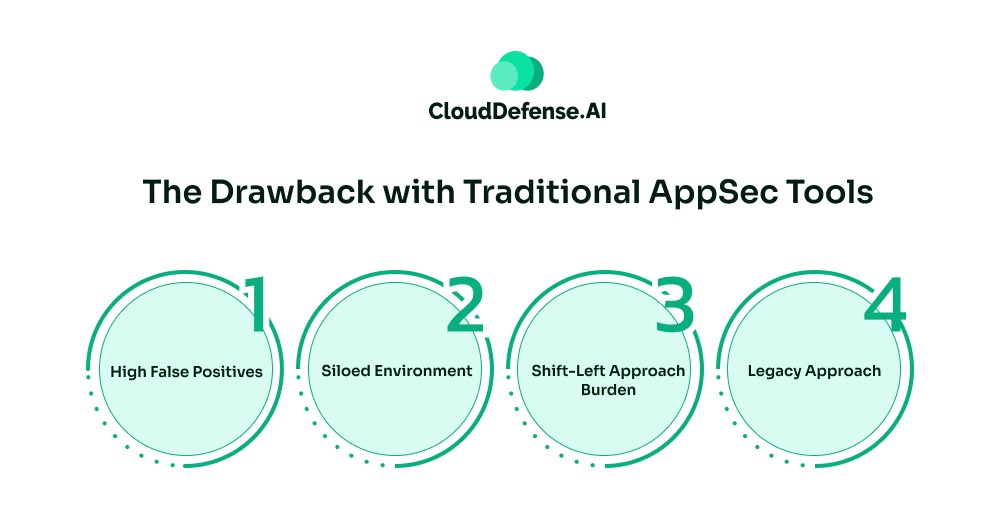
Legacy AppSec tools are the foundation of modern application development. SAST, SCA, DAST, and other tools had been effective when application deployment was slower. However, as modern cybersecurity has advanced and organizations are shifting to a faster release cycle, traditional security tools are falling short.
The main drawbacks the legacy tool introduces are:
- High False Positives: Traditional tools like SAST and DAST form the backbone of AppSec. However, with an increasing number of threats, these tools produce a high signal-to-noise ratio. Rigid rules, preset pattern matching, and a lack of contextual awareness are the main reasons behind significant false positives. Since security analysts have to sift through all alerts, it not only causes high alert fatigue but also delays response.
- Siloed Environment: Many legacy AppSec tools don’t integrate natively with modern CI/CD pipelines or the IDE. These tools mostly operate with a separate dashboard, forcing professionals to break their workflow and trigger scans for different processes. Moreover, professionals also have to manually triage the alerts separately from the dashboard. The frequent context switching makes security an obstacle to operation and ultimately increases Mean Time to Remediation.
- Shift-Left Approach Burden: Every modern enterprise is mandating a “shift-left” approach to catch all the threats at the earliest during development. However, manually triaging these complex alerts makes the job difficult for developers who aren’t trained on different security tasks. Moreover, the security alerts only highlight the issue, not how it can be solved with actionable information. Thus, developers are left clueless with a huge list of flaws that they need to fix.
- Legacy Approach: All modern applications are dependent on different APIs, microservices, repositories, and open source dependencies. Importantly, they are based on a complex architecture that changes dynamically according to requirements. As a result, traditional tools struggle to ingest data or map the data flow between the components. Thus, static security tools aren’t able to cope with the dynamic nature of modern cybersecurity, as they only offer static posture of all the vulnerabilities.
Why QINA Pulse is a Game-Changer in AppSec Automation?
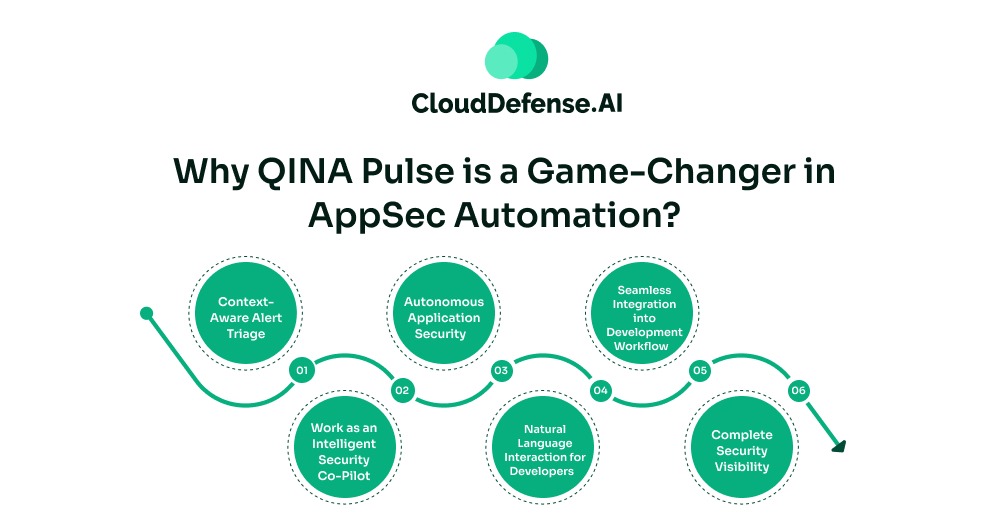
Now, it boils down to the question” Why QINA Pulse is a game-changer in AppSec automation?” Well, QINA Pulse serves as a next-generation AI security assistant that is built to streamline AppSec automation.
Here are the key reasons why QINA Pulse is a game-changer AI tool for modern leadership, developers, and security analysts:
Context-Aware Alert Triage
A significant roadblock to effective AppSec automation is high false positives stemming from a lack of contextual triage. Standard security scanners like SAST or SCA lack contextual analysis, which causes the tool to flag every possible flaw as a vulnerability.
However, QINA Pulse solves it by utilising intelligent context-aware analysis along with predictive analysis. It ingests data from every source to understand the developer’s logic, business logic, data flow, and code reachability.
It also analyzes the environment where the flawed code would be implemented. Based on all the aspects, it eliminates the dead code and provides a smartly prioritised alert to the developer’s environment. It enables developers to focus on the threat that matters.
Work as an Intelligent Security Co-Pilot
Incorporating the Shift-Left approach in SDLC has always been a daunting task as the responsibility for application security shifts to developers. Standard security tools are difficult to use and don’t offer guidance when an alert is received. QINA Pulse solves the issue by operating as an intelligent co-pilot.
Pulse is not only a security tool, but it also serves as a next-gen security assistant that helps enterprises to introduce the Shift-Smart approach along with the Shift-Left Approach. Rather than serving as a vulnerability finder, it assists developers by providing contextual remediation guidance with code snippets.
Pulse also highlights where the changes need to be made. For defined vulnerabilities, Pulse also proposes automated patches that can be executed upon the developer’s approval. Basically, it helps in establishing DevSecOps and maintaining compliance with regulatory frameworks by mapping code changes.
Autonomous Application Security
Unlike many automated AppSec tools that work in an orchestrated framework, QINA Pulse works autonomously. It leverages generative AI and ML that understand the specific application and infrastructure, and adapts accordingly.
Pulse continuously learns by ingesting data from every source. It tweaks its testing strategy according to application work and ensures maximum effectiveness. QINA Pulse is a game-changer AI tool that can autonomously schedule scans based on code changes.
Moreover, it can schedule DAST testing based on the SAST analysis. Pulse is also known for leveraging behavioural analytics to create a baseline behavior for applications so that it can autonomously hunt for zero-day exploits.
Natural Language Interaction for Developers
The natural language interaction through the security assistant is another answer to the query of “why QINA Pulse is a game-changer in AppSec automation”. For developers, dealing with application security is always a hassle due to the complexities associated with it. Developers have to brainstorm many security aspects as they lack deep security knowledge.
However, Pulse solves this issue by allowing developers to interact with the security assistant in English. It democratises complex security data and queries so that every developer can interact and understand complex security terms. It eliminates the need to go through a complex UI to trigger a scan or provide any command.
Developers can simply interact with Pulse in plain English and provide commands like “Run a code security scan on the last ten commits”. Ultimately, it eliminates all the barriers for developers and enables them to ensure optimum code security with ease.
Seamless Integration into Development Workflow
QINA Pulse is designed to integrate natively with numerous CI/CD pipelines and IDEs. It delivers all the alerts and reports directly into the IDE, preventing developers from context switching.
Pulse serves as a constant next-gen security assistant that requires no complex integration process to integrate into an enterprise’s development workflow. It supports more than 50+ enterprise tools, which include Jira, Slack, GitHub, Jenkins, and many more.
Complete Security Visibility
A major reason many enterprises are adopting QINA Pulse is its ability to offer real-time visibility into the security posture. It continuously ingests threat data from all the supply chains, like packages, repositories, containers, and other sources.
Pulse translates them into actionable security metrics in the unified dashboard. This allows business heads to identify any gap in the security strategy and allocate resources accordingly to ensure an optimum security posture.
How QINA Pulse Offers Value In Different Job Roles?
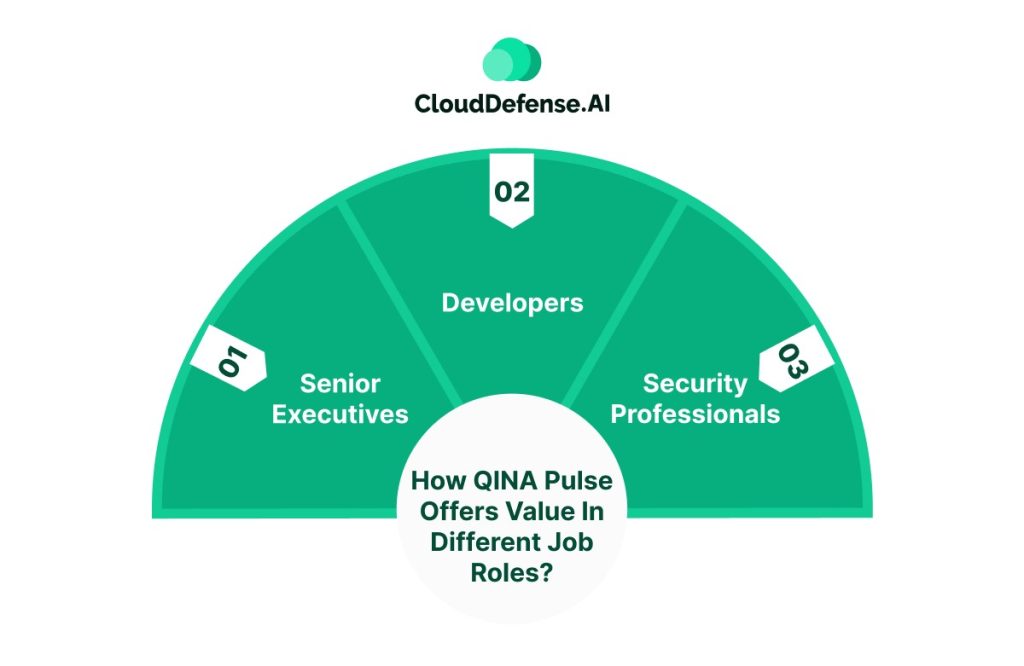
To understand why QINA Pulse is a game-changer in AppSec automation, it is important to understand how it adds value to different job roles.
- Senior Executives: Through QINA Pulse, executives and CTOs are able to achieve high-pace development without compromising security. Fixing vulnerabilities becomes cost-efficient while ensuring continuous compliance.
- Developers: Pulse has made code security effortless for developers while maintaining a shift-left approach. Developers can address security from the development workflow without switching context and write queries in plain English.
- Security Professionals: Security professionals benefit highly from Pulse. It not only helps them with proactive threat hunting but also automates the triaging process with a priority threat report. It helps them to drastically reduce MTTR.
The Bottom Line
Achieving complete application security automation is no longer a goal; it has become a necessity for every modern enterprise. The current automated security tool is unable to cope as the applications are becoming more complex and the attack surface is expanding.
QINA Pulse is enabling organizations to achieve true AppSec automation that ensures high-speed delivery while maintaining an optimum security posture. It offers a unified dashboard and advanced capabilities that make code security seamless for everyone.
It prioritizes real threats and minimizes security workload, allowing teams to scale their AppSec posture with ease. From intelligent triage to complete posture visibility, there are many robust reasons that serve as the answer to why QINA Pulse is a game-changer in AppSec automation.