Traditionally, security has always been an obstacle in the development process for engineering teams. The teams are bombarded with an overwhelming number of false positives from different security sources.
It not only leads to high alert fatigue but also causes developers to resort to context switching. As a result, it creates confusion among the team, forcing them to choose between speed and security.
How can organizations overcome this serious obstacle? Enter QINA Pulse!
It serves as a security AI co-pilot that streamlines DevSecOps, enabling teams to balance between high productivity and security.
So it boils down to the question, How QINA Pulse Streamlines DevSecOps Workflows?.
This article will highlight how Pulse helps engineers to streamline their DevSecOps workflow.
Common DevSecOps Challenges Faced by Engineering Teams
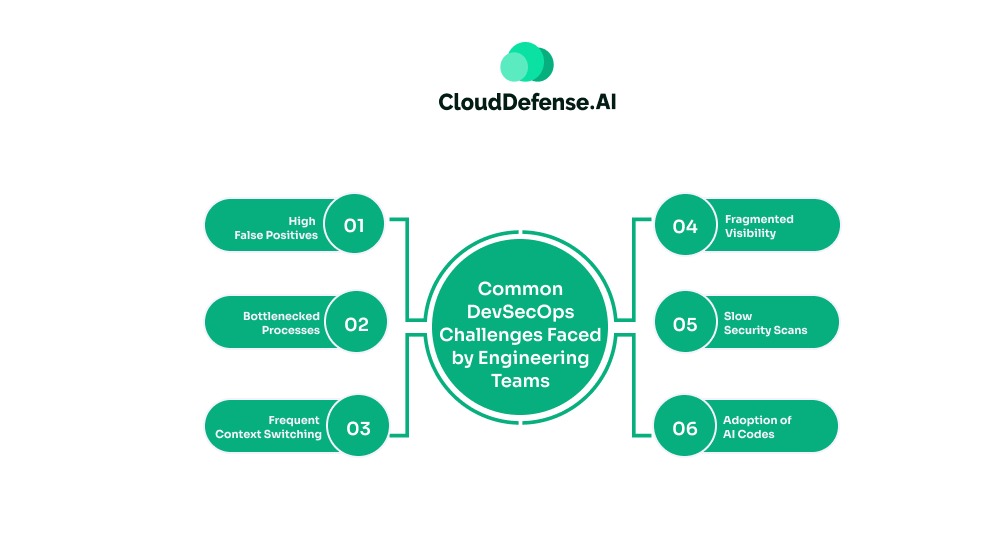
Nowadays, engineering teams are always in the relentless pursuit to deliver features quickly while keeping optimum application security. Even though DevSecOps streamlines the complete workflow, it becomes a challenge for the engineering teams.
To ensure a streamlined workflow, the team often faces a lot of challenges that arise due to numerous reasons. The common challenges faced by the team are:
- High False Positives: The huge number of false positives, along with floods of alerts, is the major challenge for engineering teams. Traditional AppSec tools like SAST lack context, causing them to create security alerts for every possible issue. Developers have to manually triage all the alerts, which ultimately leads to alert fatigue. Most importantly, it causes security blindness, causing many real threats to slip through.
- Bottlenecked Processes: Traditional AppSec workflow relies on manual processes ranging from triaging and reporting to gap analysis. This creates a bottleneck in the modern development process. Teams have to spend hours sifting through all the security findings and make an incident response accordingly, ultimately slowing down the DevSecOps workflow.
- Frequent Context Switching: DevSecOps workflow often compels developers to perform various cybersecurity tasks. They had to use multiple security tools to manage different tasks, causing them to leave the IDE and check the dashboard of the tools. This frequent context switching completely hampers the overall workflow.
- Fragmented Visibility: Most traditional tools usually operate in silos, and developers don’t have a unified dashboard for all. It causes the developers to have fragmented visibility across AppSec scanners, CI/CD pipeline, collaborative tools, and others. To ensure an optimum security posture, developers have to look for information that slows down the DevSecOps workflow.
- Slow Security Scans: CI/CD integration into the IDE is all about achieving a high-speed development approach. However, security scans hamper the speed by taking a long time to scan any build in the pipeline. Moreover, some security scans often unexpectedly fail a build. This causes the engineering team to prevent security scans in the build pipeline and leverage them afterwards.
- Adoption of AI Codes: AI code editors or assistant tools have streamlined the development workflow for engineering teams. However, the boilerplate code that is generated contains numerous vulnerabilities, and the snippets are even through public LLMs. As a result, engineering teams have to thoroughly scan all the AI codes, which act as a challenge to the DevSecOps workflow.
QINA Pulse: The Next-Generation Security Assistant
QINA Pulse is a next-generation AI security assistant that integrates with the AppSec platform and all the associated tools. It acts as a context-aware security assistant that enables engineering teams to perform different tasks through simple English commands.
The dedicated chat support allows engineering teams to streamline all the DevSecOps tasks. Pulse not only understands all the business context and compliance frameworks but also business demands and team workflows.
It enables the security co-pilot to use the context to automate workflow orchestration, security scans, triage, and reporting. It holds the capability to perform business impact analysis and provide remediation action suggestions accordingly.
How QINA Pulse Streamlines DevSecOps Workflows
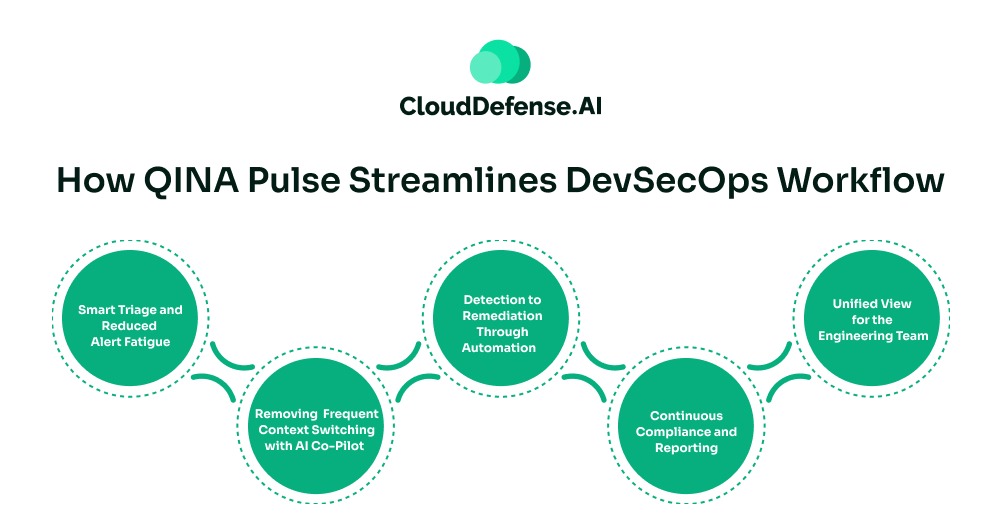
The arrival of QINA Pulse in the DevSecOps workflow brings a significant shift. This intelligent security assistant introduces security gates from the beginning and automates most in the CI/CD pipeline, minimizing all the frictions. The QINA Pulse benefits the organization in many ways, especially the DevSecOps.
Here is how it streamlines the DevSecOps workflow:
Smart Triage and Reduced Alert Fatigue
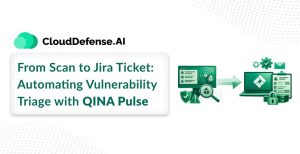
One of the biggest roadblocks to DevSecOps workflow is managing floods of alerts, which include false positives from AppSec tools like SAST, DAST, and SCA. However, the integration of QINA Pulse eliminates this issue through context-aware scanning and intelligent triage. Pulse utilizes a multi-stage contextual filtering where it performs:
- Reachability analysis
- Code property graph analysis.
- Context extraction
- LLM-backed reasoning
It not only scans the code but also evaluates the context of the application, business goal, and security impact. It performs intelligent triage on all the security findings.
The impact?
It prevents engineering teams from going through hundreds by offering and provides them with intelligently prioritized alerts. It cuts down false positives by a large margin and offers the team only real and exploitable threat alerts.
Removing Frequent Context Switching with AI Co-Pilot
While working with multiple tools like SAST, cloud-security tools, and SCA, engineering teams had to switch dashboards frequently to carry out different security tasks. It not only reduces DevSecOps productivity but also leads to dashboard fatigue.
Pulse acts as a savior where it integrates with all the AppSec tools and provides a chatbot, making security a part of the workflow. It eliminates the need for engineering teams to craft complex query language and utilize a conversational interface to interact in plain English.
As a result, the team gets a streamlined DevSecOps workflow:
- Engineering Teams’ Query on Pulse: “Find all the vital vulnerabilities from the recent code changes.”
- QINA Pulse’s response: It quickly provides a detailed vulnerability report directly into the engineering team’s IDE.
Engineering teams don’t have to switch to a different dashboard, and they can ask Pulse directly from their IDE to perform a task. It greatly transforms the security orchestration into simple tasks and streamlines the complete workflow.
Detection to Remediation Through Automation
QINA Pulse not only helps engineering teams automate the detection process but also brings automation to the remediation workflow. It provides the engineering team with different ways to quickly respond to the threat:
- AI-backed remediation guidance with context-aware details that help to easily fix the issue.
- AI-based automated playbooks that can be deployed to trigger patches, fix dependencies, and tweak configuration according to security policy.
- Remediation workflow orchestration where the security co-pilot automatically opens and fixes the security threat when a specific group of vulnerabilities is detected.
As a result, the team is able to quickly fix it without breaking the build. Pulse also enables the team to enhance the mean time to remediate (MTTR), which ultimately helps with DevSecOps acceleration.
Continuous Compliance and Reporting
For engineering teams, staying compliant with all the industry standards like GDPR, SOC II, HIPAA, etc, is a vital and time-consuming task. However, QINA Pulse completely streamlines the compliance approach.
It integrates natively directly into the CI/CD pipeline of the organization. As a result, it embeds compliance directly into DevSecOps, minimizing the need for manual evidence collection and reporting.
So, how QINA Pulse simplifies DevSecOps tasks in compliance adherence? It streamlines the process by:
- Continuous monitoring of the development environment against set regulation requirements.
- By integrating into the CI/CD pipeline, it implements organization-specific security policies. It is specially configured to block any build when it categorises “high-impact” or “critical” during AI triage.
- Automated compliance gap analysis along with risk scoring to prevent any compliance breach and minimize repetitive assessments.
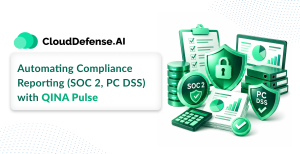
QINA Pulse also helps engineering with automated reporting, which helps in streamlining the workflow. It automates the process of mapping technical controls to regulatory requirements.
As a result, it enables the team with on-demand reporting. The engineering team just put a command to create an audit-ready report for any security standard, and it will immediately provide it. Thus, it transforms rigorous compliance tasks into a continuous process.
Unified View for the Engineering Team
A siloed view of security issues by different engineering teams has always been a roadblock in the DevSecOps workflow. A developer might consider a security issue as a simple and avoidable bug.
Whereas the security team might consider the security issue as a serious threat to compliance. But QINA Pulse eliminates the siloed view by providing a singular pane.
How does it simplify? It does it by:
- Helps the Dev and Sec team to overcome siloed Excel sheets and PDF reports with a shared report through Slack in the IDE.
- The collaborative Chatops enables the team to take a unified approach to any security threat and remediate it through a single command.
- The chatops of Pulse help every team member to track all the security activity and approach it accordingly.
Bottomline Line
How QINA Pulse simplifies DevSecOps tasks? It simplifies the workflow by taking various intelligent automated approaches that eliminate all the friction. It integrates natively into the development environment as a security co-pilot and enables the engineering team to treat security as a streamlined task.
One of the major QINA Pulse benefits is its ability to use AI and ML to perform contextual scans, intelligent triage, and automate remediation. It not only improves the productivity of the engineering team but also enables it to maintain high-pace development without sacrificing security.
It turns security into a continuous partner in the development workflow and eliminates any friction between speed and security. Want to get a hands-on review of how it streamlines and facilitates DevSecOps acceleration? Book a free demo now!