In the modern application development process, high-velocity delivery is no longer a speciality- it has become a baseline requirement for every team. Developers are using CI/CD pipelines and agile methodologies to align with modern, high-speed development approaches. However, traditional application security testing methods- relying on a rule-based approach and manual oversight are struggling to keep pace.
Even though SAST and DAST tools have evolved to meet modern requirements, they still generate a lot of alerts, including false positives, and force developers to switch contexts. It results in a security bottleneck, which ultimately slows down the development process.
Thus, enterprises are gradually inching towards a new approach: AI-Powered security automation. It isn’t only about scanning code faster; it is about a “shift smart” approach where AI and ML work together to learn, think, and deliver autonomy at scale. This article discusses how AI-powered security automation is revolutionizing application security.
Drawback with Traditional AppSec Tools
With time, application development is getting complex as developers are utilizing multiple APIs, microservices, libraries, and open-source dependencies. Furthermore, the arrival of AI code editors has added to the complexity. It is unable to cope with complex and rapid development approaches.
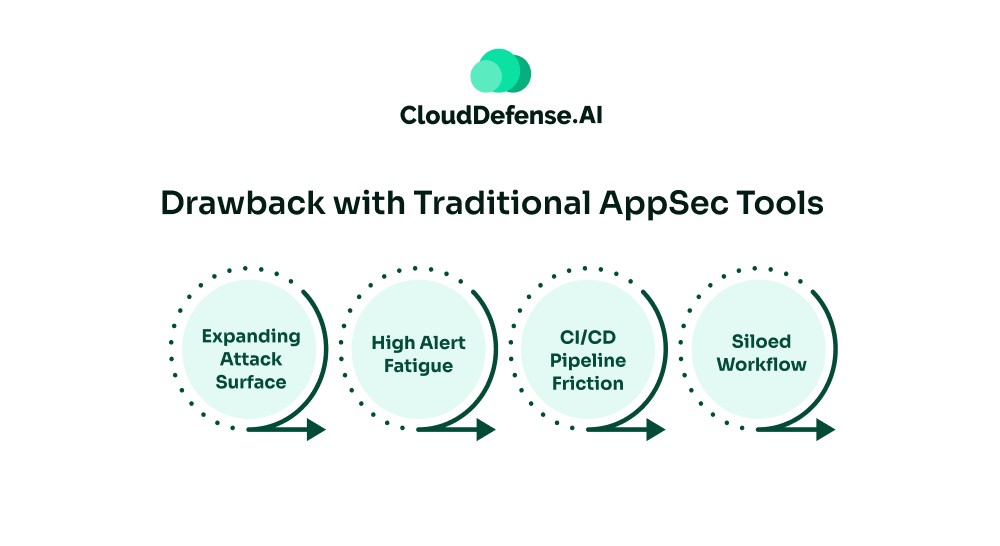
The core drawbacks of traditional AppSec tools that have resulted from modern changes:
- Expanding Attack Surface: Modern applications are based on multiple dependencies, each serving as a potential source for vulnerabilities. API endpoints are the most vulnerable points as they are exposed to the public internet. In addition, numerous third-party libraries are utilized that often carry vulnerabilities. Since the attack surface is expanding, traditional AppSec tools aren’t able to cope with this dynamic nature.
- High Alert Fatigue: Many AppSec tools are based on legacy systems that rely on preset behaviour baselines and scanning rules to flag threats. The lack of contextual understanding causes the tool to generate numerous alerts, most of which are false positives. This ultimately causes the critical vulnerabilities to be buried under low-priority threats.
- CI/CD Pipeline Friction: Modern CI/CD pipelines are all about high velocity. Whereas AppSec tools take hours to run security checks. This not only delays the security response but also breaks the CI/CD pipeline. This forces developers to consider meeting the application delivery deadlines over maintaining stringent security scans. On many occasions, developers have to skip security checks to streamline the development process.
- Siloed Workflow: Security professionals and developers work in different environments. They have to switch to different security dashboards from IDE to work on different application security tasks. They have to rely on ticketing systems to relay vulnerability reports, which ultimately slows down the incident response and remediation process.
What is AI-Powered Security Automation?
AI-Powered security automation is the process of leveraging artificial intelligence, machine learning, natural language processing, and intelligent orchestration. It enables teams to automate the process to continuously identify, investigate, and remediate vulnerabilities across the SDLC with no or minimal human intervention.
The security automation doesn’t act as an AI security tool. It rather serves as an intelligent security layer that is spread across the SDLC, CI/CD pipeline, and application environment. The main aspect is that it provides security and engineering teams with a unified system to communicate and orchestrate.
AI in AppSec continuously ingests data from different sources to learn about the system. This allows the security automation to adapt according to the application’s environment and behavior, and tune its detection process accordingly. The process involves a contextual security assessment, which allows it to identify both known and zero-day threats that traditional automation often fails to detect.
AI-Powered Automation is Revolutionizing Application Security
AI-Powered security automation has completely changed how organizations look at application security. It utilizes artificial intelligence along with ML and LLMs to introduce autonomous security capabilities and intelligent context in the scanning process.
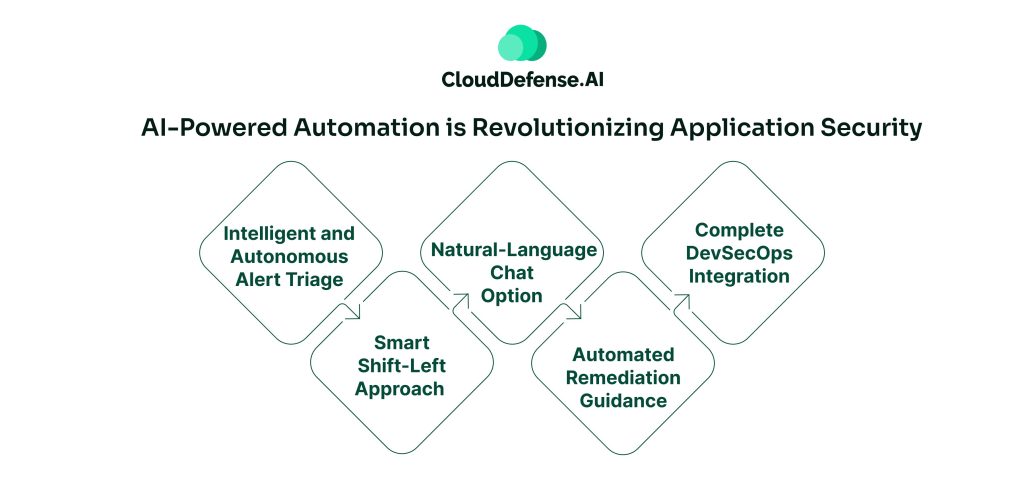
Here is how AI-powered security automation revolutionizes AppSec:
Intelligent and Autonomous Alert Triage
Modern AI in AppSec is leveraging ML and LLMs to understand the context of every flagged code. AI engines are performing deep analysis on reachability, business logic, data flow, and developers’ intent to understand whether the vulnerability is exploitable or not.
It understands whether end users can access the vulnerable code. Based on the analysis, it eliminates the dead code and prioritizes alerts based on their severity. Furthermore, it eliminates all the dead code and helps teams to focus on critical alerts.
Smart Shift-Left Approach
With AI-powered security automation, security and development teams can achieve true shift-left implementation. It embeds security intelligently at the earliest and into every phase of the development pipeline.
During pull requests, it can easily identify any insecure code patterns. Many AI security tools also correlate the code analysis data with dynamic runtime behavior to understand the true context of the code. This enables the team to identify flawed code in the commit stage, making it less expensive to remediate.
Natural-Language Chat Option
A great thing about AI in AppSec is that it is allowing security professionals and developers to move beyond siloed dashboards and adopt ChatOps. It allows teams to interact and orchestrate security tasks in just natural language. These ChatOps enable collaboration on different security tasks as the information is available to everyone through the ChatOps.
Automated Remediation Guidance
The revolution through AI-powered security automation is not only about identifying vulnerabilities autonomously; it also revolutionizes how teams remediate them. It provides teams with automated remediation guidance with context-specific patches for every vulnerability.
Some AI security tools even provide code snippets in the IDE or specific dashboard so that the vulnerabilities can be quickly fixed. For low-priority vulnerabilities, it can generate ready to merge Pull Requests to fix flawed code while ensuring it maintains the organization’s code style.
Complete DevSecOps Integration
The integration of AI in application security ensures that security is a continuous background process. It makes sure security is integrated into the development environment, including the development pipeline.
Most of the tools based on AI in AppSec offer seamless integration with native tools. This allows the AI security tools to perform scans and deliver reports in split seconds, whether a particular Pull Request is adhering to the organization’s security policy.
QINA Pulse: The Leading Standard for AI-Powered Security Automation
Among most AI security tools, QINA Pulse has emerged as the premier tool that offers an intelligent and sophisticated AI-powered security automation. It serves as a security assistant that leverages AI, ML, and LLMs to integrate organically into the developer’s workflow.
The security copilot is designed precisely to help teams manage complex application security tasks through automation. It is designed meticulously to help teams maintain a high-velocity DevSecOps approach.
Reasons Made QINA Pulse an Industry Standard for Security Automation
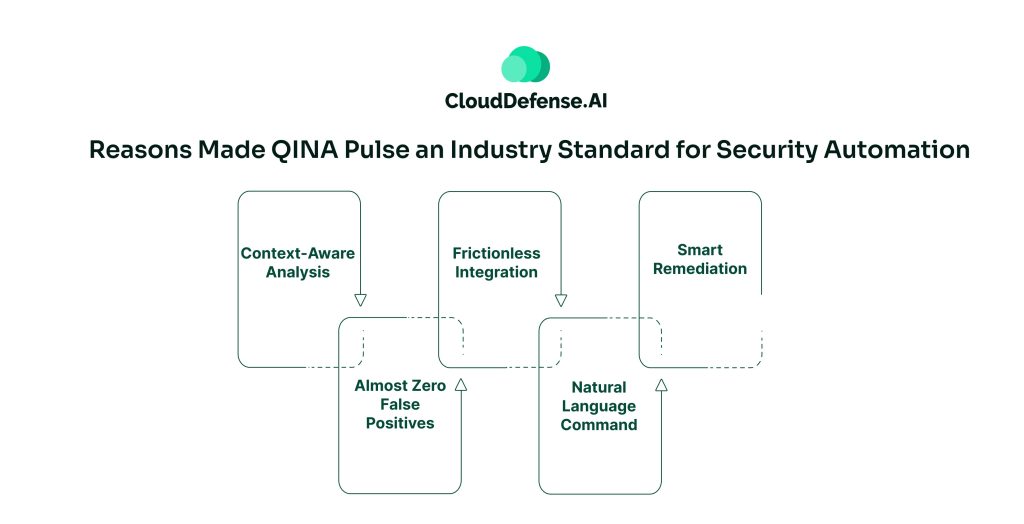
- Context-Aware Analysis: Unlike other tools based on AI in AppSec, Pulse is designed to perform context-aware analysis. It understands the context behind a flawed code, including business logic. During triage, it performs predictive and reachability analysis to evaluate the flawed code reach and eliminate all dead code. Based on the analysis, it provides a prioritized alert report to developers.
- Almost Zero False Positives: Pulse utilizes an intelligent triage process that eliminates almost all the false positives. The AI models are trained on millions of secure and insecure code patterns. Furthermore, it is continuously learning by ingesting data from different tools. Thus, it virtually eliminates most false positives from the report.
- Frictionless Integration: One of the major reasons behind the huge popularity of Pulse is its frictionless integration with 50+ enterprise tools. It seamlessly integrates with tools like GitLab, Slack, Jira, and many more. Furthermore, teams won’t have to go through any configuration process to integrate it.
- Natural Language Command: It serves as a security assistant that can take commands from developers and security professionals in plain English. It integrates into the IDE and CI/CD pipeline and enables developers to put security commands in plain language. Whether it is to execute scans or get reports, Pulse delivers reports within a few seconds.
- Smart Remediation: Unlike other AI security tools, Pulse not only provides reports of the vulnerabilities, but it also provides detailed remediation guidance. It provides detailed code snippets, and in many cases, it provides developers with the right location where teams can work. For specific vulnerabilities, it even enables the team to automate the remediation process.
Bottom Line
In 2026, AI-powered security automation is revolutionizing how enterprises approach application security. Powered by AI-based automation, enterprises are now able to intelligently triage alerts, automate fixes, and maintain compliance from a single dashboard.
Modern tools based on AI in AppSec, like QINA Pulse, are helping enterprises to scale their application security at the same pace as the application development. It is empowering developers to ensure optimum code security without compromising on the development speed. Importantly, it allows organizations to adapt to the Shift Smart approach and take AppSec as an advantage.