In the modern era, where speed and security are top priorities, developers are building their applications on an array of open-source dependencies. To accelerate the SLDC, development teams are relying on a heap of third-party dependencies to build their application. However the reliance on third-party libraries serve as a huge task for security teams. They have to secure the supply chain and ensure timely security patch to prevent bottlenecks to CI/CD pipelines.
For years, teams have been relying on traditional SCA scans. However, in the modern high-velocity development approach, a manual or semi-automated SCA workflow is no longer efficient due to slow scans and high volume of alerts with minimal context. While developers are interrupted, security teams face high fatigue.
To accelerate SCA scans, organizations are shifting to automated SCA scans that are offered by context-aware tools like QINA Pulse. In this article, we will explore how QINA Pulse integrates with the system and enables enterprises to achieve an automated SCA workflow.
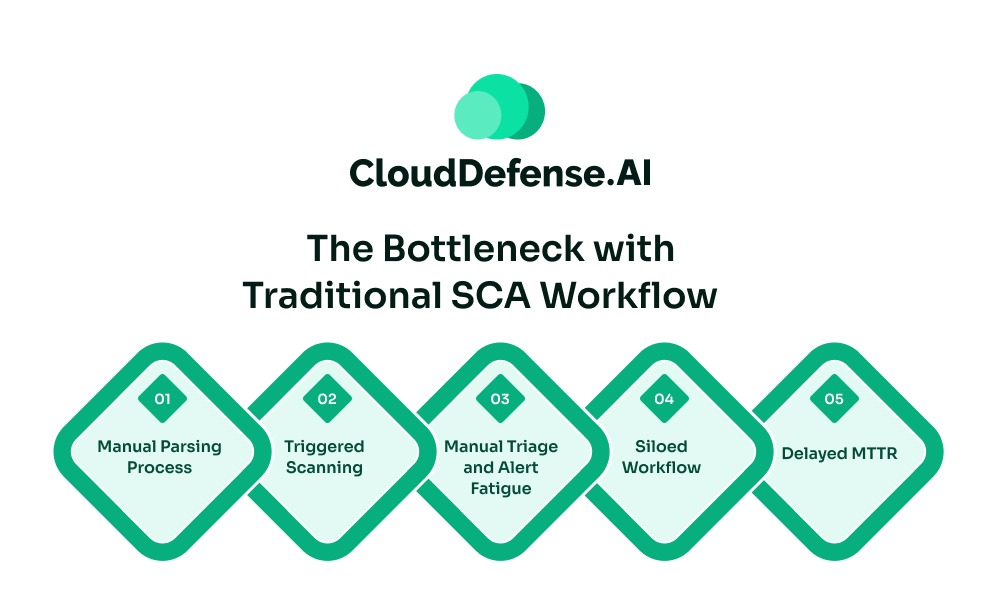
The Bottleneck with Traditional SCA Workflow
Traditional SCA workflow has been one of the crucial pillars of AppSec, where SCA tools scan the codebase, generate the list of identified vulnerabilities, and send alerts. However most developers are now relying on AI-code that utilizes multiple dependencies to accelerate development cycle.
However, the traditional workflow is failing to cope because:
- Manual Parsing Process: In traditional SCA workflow, teams have to manually update the dependency manifest on the SCA tool. Based on the manifest, the tool parses them, cross-references the CVE, and generates reports. However manual manifest workflow causes many transitive threats to go unnoticed. This is a serious issue because many modern codebases utilize an array of transitive dependencies, making it impossible for the team to keep track of them in a polyglot environment.
- Triggered Scanning: All legacy tools trigger scans based on specific events. It doesn’t run scans continuously and the scans are mostly triggered during code commit, at specific gates of CI/CD pipeline and during release cycle. However, it creates a gap and causes zero-day threats to go undetected.
- Manual Triage and Alert Fatigue: All the standard SCA tools generate a huge number of security alerts, many of which are false positives. Teams have to sift through those large lists of vulnerabilities and triage them. Since most of them are irrelevant or unexploitable by context, teams develop a habit of ignoring a lot of alerts. Moreover, heaps of alerts from every SCA scan also lead to alert fatigue, as it is a highly time-consuming process.
- Siloed Workflow: A major bottleneck with these tools is the siloed workflow and lack of integration with developers’ workflow. As a result, teams have to switch from their IDE or other environment and work on a clunky dashboard where all the scan reports are stored. Without direction integration, all the findings remain unnoticed causing attackers to exploit the vulnerabilities.
- Delayed MTTR: All the reports only highlight the security findings and don’t offer any context regarding how to solve the issue. Teams have to research and come up with a plausible solution to patch the threat. This increases the mean time to remediation and delays the release cycle.
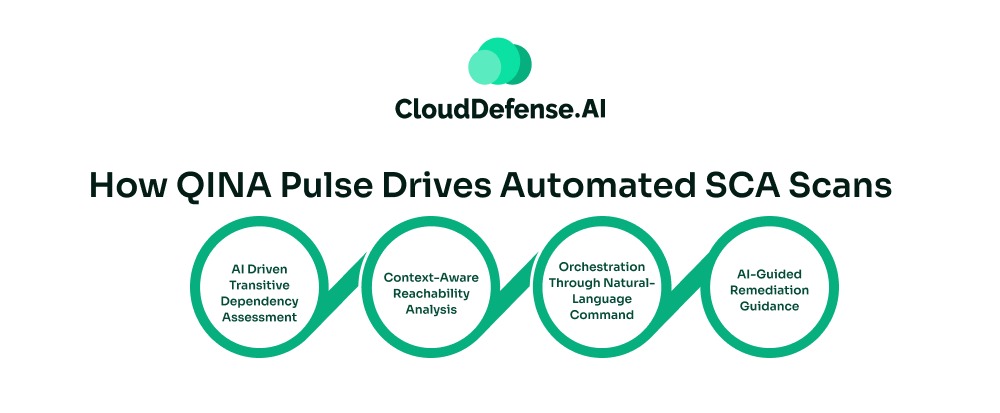
How QINA Pulse Drives Automated SCA Scans
QINA Pulse is an AI-powered security co-pilot that moves beyond traditional rule-based SCA scanning. It is a context-aware tool designed to introduce automated SCA into the DevSecOps workflow and eliminate all the bottlenecks. The tool leverages AI and ML to integrate natively with the AppSec program and make automated dependency analysis a frictionless process.
QINA Pulse brings a shift in how teams perform dependency management by ensuring continuous and contextual software composition analysis automation. It stands out from other dependency scanning automation tools with its ability to combine deep dependency scans with real-time threat intelligence and remediation guidance.
Here is how Pulse accelerate the SCA scanning process and streamline the overall dependency analysis workflow:
- AI Driven Transitive Dependency Assessment: Pulse just doesn’t rely only on manifests; it automatically discovers all the dependencies associated with an application. It creates a comprehensive dependency tree view so that teams can identify all the direct and transitive dependencies associated with applications. It automates the tree visual process for every application, enabling teams to check and identify the flawed packages in the supply chain.
- Context-Aware Reachability Analysis: A major capability that defines Pulse is its ability to perform context-aware reachability analysis. It can understand the application’s architecture and security context of each function. The tool utilizes LLM models to assess all the vulnerable functions within the libraries and dependencies utilized by the application. Based on the analysis, if it finds the path is unreachable, the dependency is deprioritized. Importantly, Pulse also analyzes whether a vulnerable open-source dependency can be exploited in the production environment. It allows teams to focus on remediating vulnerable dependencies and other productive work.
- Orchestration Through Natural-Language Command: Unlike other dependency scanning automation tools, Pulse helps the team with managing SCA workflow through natural command. Teams just have to provide commands in natural language to trigger scans, automate SCA scan alerts, or create tickets. Moreover it democratises all the security details which ultimately aids in streamlining the SCA workflow.
- AI-Guided Remediation Guidance: When a security alert becomes a true positive, QINA Pulse generates a contextual remediation guidance along with accurate code snippets. From suggesting a specific patch to a safe version upgrade, it removes the process of guesswork and secures all the faulty dependencies. In many cases, it enables teams to automate the remediation for specific vulnerabilities with a single command.
Getting Started with QINA Pulse to Accelerate SCA Scans
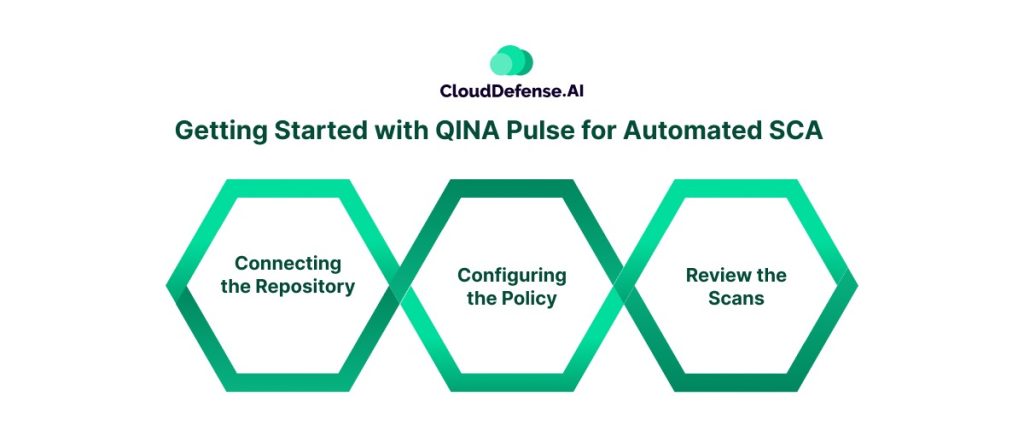
To achieve automated SCA by leveraging QINA Pulse, organization have to follow three basic steps:
- Connecting the Repository: Enterprises need to begin the process by integrating QINA Pulse to AppSec and allowing access to all the repositories. However for self-hosted VCS instances, Pulse offers an on-premises agent.
- Configuring the Policy: Once the connection is done, teams need to utilize Pulse to define their severity threshold policy for license policy rules, breaking the build, and creating blocks in the pipeline. Teams can even integrate different policy templates that aligns with the requirment of the organizations requirement.
- Review the Scans: Pulse begins the automated scanning process and sifts through all the defined manifests across all the connected repositories. After the initial setup, Pulse provides an actionable review to thereview.
Strategic Benefits QINA Pulse offers to CISOs and CTOs
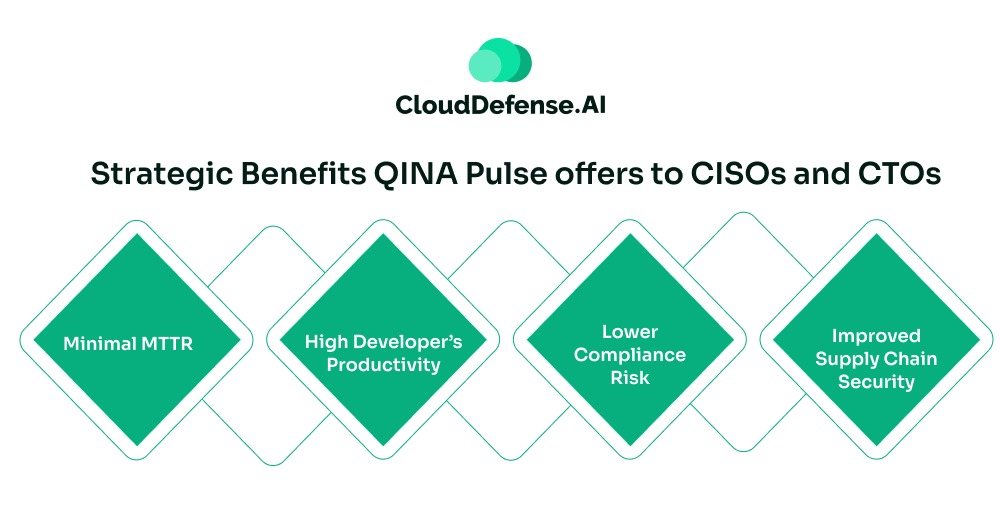
Implementing QINA Pulse for automated SCA workflow benefits the CIOs and CTOs in many ways:
- Minimal MTTR: QINA Pulse not only highlights the actual vulnerable dependency but also provides the team with contextual remediation steps. In some cases, Pulse enables teams to automate fixes for various vulnerabilities through a single command. This minimizes the time to fix all the vulnerabilities and ensures optimum incident response.
- High Developer’s Productivity: A great aspect of Pulse is that it eliminates all the manual approaches. It prevents teams from switching context and provides a security co-pilot that enables them to accomplish SCA scans through command.
- Lower Compliance Risk: With the help of Pulse, teams can automate the generation of SBOMs and compliance reports depending on SCA scans. It ensures the organization continuously meets all the regulatory requirements and stays audit-ready.
- Improved Supply Chain Security: With continuous dependency analysis and software composition analysis automation, QINA Pulse allows teams to improve their supply chain security. The ability to automatically detect malicious dependencies prevents any threat from reaching production.
Bottom Line
In the era of increasing supply chain attacks, depending upon a manual approach to manage SCA workflow is no longer an option. Enterprises need to utilize security tools that offer automated SCA to streamline the workflow. QINA Pulse perfectly meets the requirement by offering native integration to existing AppSec and implementing automated SCA.
Pulse as a security co-pilot is not just a technical upgrade; rather a strategic tool that gives enterprises a competitive edge while maintaining high-velocity development. The integration of Pulse clearly provides a significant improvement in supply-chain security posture and the team’s efficiency. Importantly, it enables enterprises to eliminate the friction between speed and security, ensuring the software supply chain remains secure, compliant and resilient.