
In modern DevSecOps culture, speed and security are non-negotiable. Continuous Integration and Continuous Development (CI/CD pipeline) serves as the cornerstone for development. Whereas a Static Application Security Testing tool helps in uncovering vulnerabilities during development.
However, as modern development and cybersecurity are becoming increasingly complicated, SAST is becoming ineffective, causing a gap between speed and security. The lack of context, high false positives, rigid rules, and frequent context switching are adding to its inefficiency. So, how can organizations navigate the hurdles?
Integration of QINA Pulse. It is an AI-powered intelligent security assistant that addresses all the inefficiencies through the orchestration and automation of SAST. This article explores how QINA Pulse automates SAST in the CI/CD pipeline and maintains optimum security without slowing development pace.
Why SAST is Falling Behind in the Era of Automation
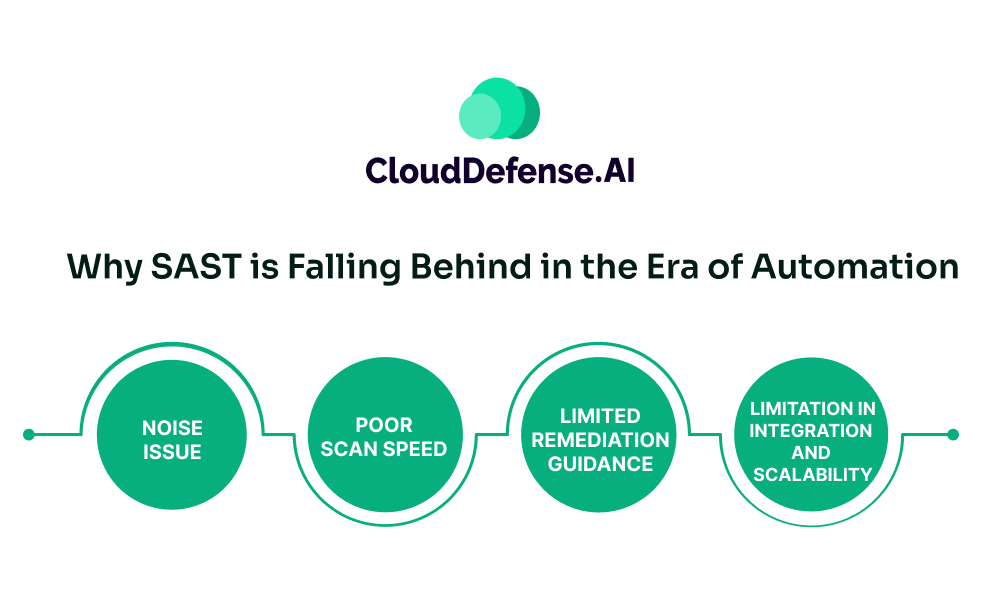
Static Application Security Testing(SAST) has been the primary tool of the CI/CD pipeline. But in today’s high-velocity development environment, it is generating more friction than streamlining security. How? Let’s find out:
- Noise Issue: Standard SAST tools without AI leverage rigid rules and preset patterns matching techniques to identify security alerts. The lack of contextual understanding makes it unable to get a grasp on the complex data flow, business logic, and the primary intent.
It causes the tool to flag any issue as a vulnerability that isn’t actually a threat. In many cases, dead code with a security issue is flagged by the tool. It not only generates thousands of false positives but also causes fatigue among developers. - Poor Scan Speed: Modern DevOps is all about speed and requires quick security scans. However, legacy tools like SAST are designed to run for a long time to identify vulnerabilities.
SAST doesn’t scan the code changes- it scans the entire codebase whenever a change is made in a line of code. Ultimately, it causes a delay in the build process and often forces developers to skip security during urgent deployments. - Limited Remediation Guidance: SAST tools are designed to identify security issues and deliver developers with security alerts- not fix them. It provides a detailed report of the security issue to developers. But not how developers can fix them within the specific development environment.
Importantly, some modern SAST tools are designed to provide remediation guidance. However, due to a lack of context, they only provide generic fix guidance that doesn’t always work. - Limitation in Integration and Scalability: Most SAST tools aren’t designed to work with most languages and frameworks. They support a handful of environments, causing a limitation in integration capability. A large number of SAST tools lack support for polyglot environments.
As a result, development teams have to switch frequently and manage multiple tools. Along with integration limitations, SAST tools also have scalability issues. The use of diverse codebases, coupled with the increasing use of AI code, is making the tool inefficient to scan and identify.
What is QINA Pulse?
QINA Pulse is an advanced and AI-powered security assistant that streamlines and orchestrates application security workflows. It is a powerful context-aware tool that utilizes AI and ML to automate different security tasks through natural English commands. This AI co-pilot integrates with the organization’s AppSec platform and CI/CD pipeline.
The smart context awareness capability helps it to understand the context of the application. As a result, it is able to intelligently orchestrate and help with static code analysis automation in the CI/CD pipeline. It also integrates with other collaboration tools to not only automate the detection and triage but also the remediation process.
Core Mechanism in SAST Automation
QINA Pulse intelligently automates SAST in the CI/CD pipeline using three primary mechanisms:
- Smart Context Aware Scanning: QINA Pulse not only scans the syntax of the code but also understands it. The security assistant utilises AI and ML to understand the code flow and business logic. It scans every detail, including role and permission. This enables the security co-pilot to assess whether a particular vulnerability is exploitable or not.
- Autonomous Triage: A core mechanism that Pulse brings on board is autonomous triage. It utilizes QINA Clarity’s 4-stage analysis for triaging all the SAST alerts. The intelligent triaging filters out all the false positives before they revert in the chat ops. Moreover, it provides the developers with smartly prioritised alerts, helping in responding to threats that can severely impact.
- Natural Language Processing: Pulse is built with natural language processing that enables developers to interact with application security in plain English. The developers simply command the tool, and it will perform the task autonomously. The real-time data aggregation enables it to put complex terminologies in simple English.
QINA Pulse Automation of SAST in CI/CD Pipeline
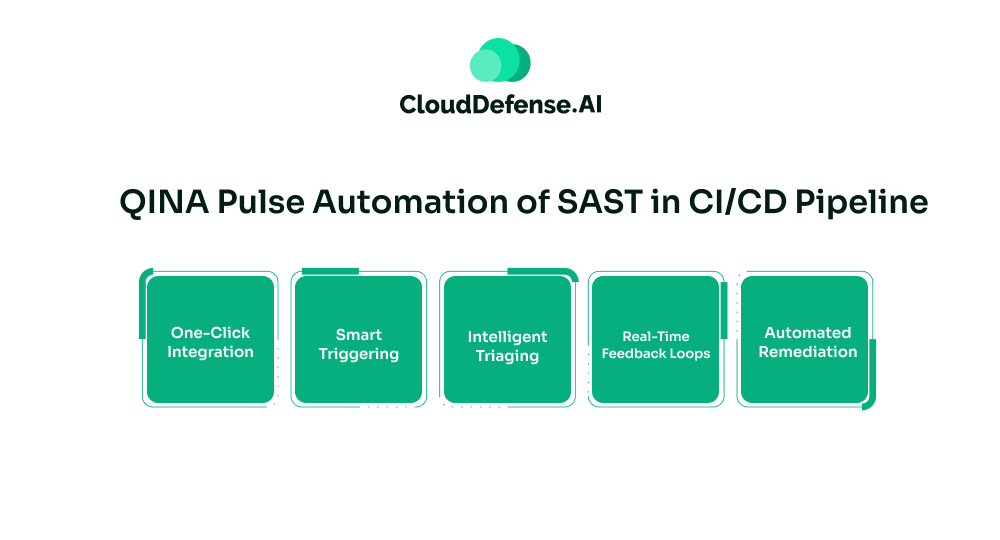
QINA Pulse automates the SAST in the CI/CD pipeline by integrating into different stages of the developers’ workflow. Here is how QINA Pulse automates the SAST:
One-Click Integration
The workflow to automate SAST in the CI/CD pipeline begins with seamless native integration to any CI/CD platform. It integrates easily into all popular platforms along with their AppSec. After integration, it quickly scans the application, repositories, and containers associated with it.
Smart Triggering
QINA Pulse eliminates the lengthy manual scanning initiation in the CI/CD pipeline. It enables the developers to configure the triggering of automated scans based on certain events. These events are:
- Pre-Commit or Pull Request: When a developer writes code, Pulse can automate SAST to run an intelligent scan. The developers just have to put the specific command in plain English. It will ensure that when a PR is open, it will scan the code changes.
- Scheduled Scan: A unique capability of Pulse is that it allows developers to initiate deep dive scans for the main branch. It will ensure any zero-day pattern is detected as it emerges.
Intelligent Triaging
The biggest issue with SAST is false positives. QINA Pulse minimises all the noise by integrating intelligent triaging for all the security alerts from SAST. It utilizes the proprietary 4-stage analysis pipeline to filter out all the security alerts. The 4-stage process involves:
- Dead Code Detection: The code flow and its execution are thoroughly analyzed. In this stage, all the unreachable codes are eliminated.
- Context Extraction: AI analyzes the intent of the reachable codes and extracts all the context.
- LLM Analysis: LLM then reasons the security alerts with business context. It analyzes the code by tallying against billions of lines of secure and insecure code patterns.
- Intelligent Prioritization: In the end, the LLM output and reachability context are taken into consideration for final triaging. It intelligently classifies the result and provides a prioritized vulnerability report.
Real-Time Feedback Loops
QINA Pulse doesn’t discard the findings; rather, it pushes them directly into the developer’s native environment. As a result, developers can view all the findings without switching context. All the security warnings are fed to their IDE as developers type or generate code. It provides vulnerability reports or snippets as inline comments in Pull Request or Merge Request.
Automated Remediation
QINA also enables automated remediation in the CI/CD security automation effort. It doesn’t just identify vulnerabilities; it helps developers remediate them. When a vulnerability is detected by SAST tools, Pulse helps developers with code snippets that can patch the vulnerability.
The security co-pilot can also be automated to remediate specific types of issues autonomously. QINA Pulse, through integration with Jira or similar, can automatically generate tickets, carrying vulnerability context, impact, and remediation guidance.
Benefits of QINA Pulse SAST Automation
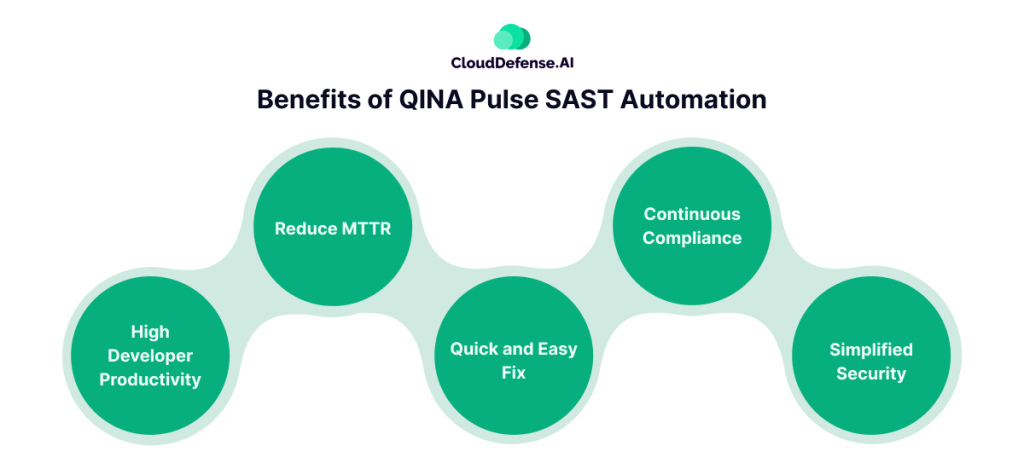
Static code analysis automation through QINA Pulse benefits organizations. It introduces intelligent automation in every step. How? Let’s find out.
- High Developer Productivity: QINA Pulse SAST automation filters out all false positives. Plus, it provides an intelligent security assistant. It enables developers to focus less on debugging threats and spend more time on application development.
- Reduce MTTR: Pulse by integrating into SAST not only quickly scans for vulnerabilities but also helps in automating the remediation. Vulnerabilities can be fixed with a simple English command in minutes after they have been identified.
- Quick and Easy Fix: A huge benefit of this security co-pilot is that it can identify vulnerabilities in pull requests and branches. All that through simple commands by developers. It significantly reduces the remediation cost and maintains a high-velocity development approach.
- Continuous Compliance: Pulse can be configured and automated to continuously collect details of SAST activity along with the security findings. It can be automated to align SAST with the regulatory requirements. It will not only streamline the audit preparation but also maintain continuous compliance.
- Simplified Security: The natural language processing transforms all the security jargon into simpler terms. This allows non-security experts to easily understand complex security data and carry on tasks accordingly.
Bottom Line
A few years ago, automated SAST was just a concept. But next-generation security tools like QINA Pulse are making it a reality. By automating SAST using AI and ML, Pulse introduces intelligence in every step of the CI/CD pipeline. In this way, it transforms SAST from reactive to proactive and automated security tools. It also ensures security can cope with the speed of code, allowing organizations to deploy faster. Importantly, it streamlines the path for organizations aiming to implement DevSecOps and achieve a “shift smart” approach. Book a quick demo to implement QINA Pulse into your SAST strategy.