In today’s cybersecurity world, the number of security threats is not only growing drastically, but they are also getting sophisticated in nature. Organizations nowadays are leveraging multiple security scanning tools to identify threats. These security scanners generate a barrage of alerts. This deafening security noise not only creates alert fatigue but also makes it a difficult task to differentiate between critical and benign security issues.
Importantly, the security scanners prioritise security alerts based on static rules. As a result, developer and security teams have to go through thousands of alerts, leading to delayed incident response.
What does an organization need? An advanced security tool built on security prioritisation with AI capability. When an AI-powered security prioritization approach steps in, it will help the team to focus on threats that require immediate fix.
In this article, we will explore how security prioritisation with AI offers a transformative approach and helps in maintaining security posture.
The Challenge of the Traditional Manual Security Approach
Standard security scanners with traditional security prioritisation have always been a cornerstone of an organisation’s AppSec strategy. However, these tools generate a significant number of alerts daily. Moreover, the tools don’t prioritise alerts. Even if the tools prioritise, they are categorized according to the standard CVSS score.
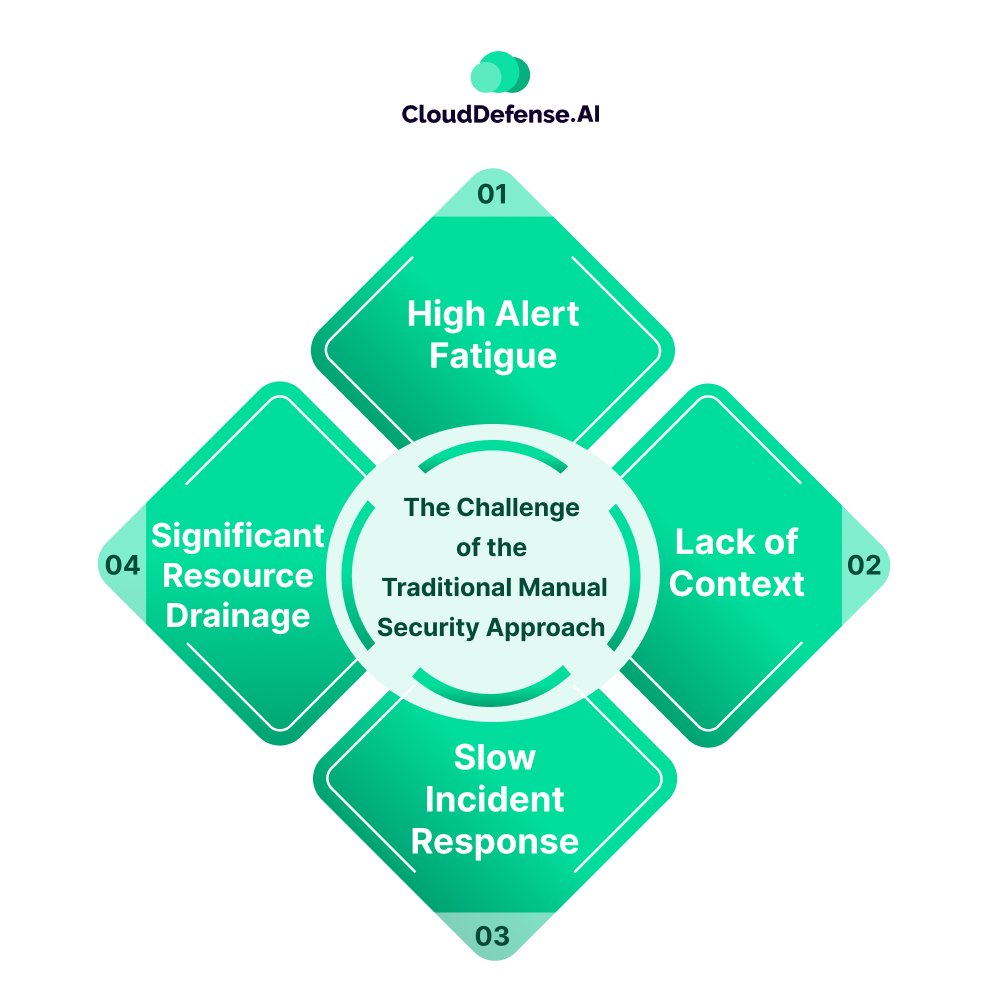
This manual approach leads to different issues, such as:
- High Alert Fatigue: Developers are bombarded with a huge number of security alerts on a daily basis. The lack of smart prioritisation causes the team to triage all the alerts one by one. It ultimately leads to high alert fatigue.
- Lack of Context: A lot of security scanners used by modern organisations utilize generic security scores like CVSS to categorize security alerts. The prioritisation process doesn’t consider the context of the organization’s IDE, application type, assets’ criticality, and other aspects. In the end, it provides the team with poorly prioritised alerts.
- Slow Incident Response: When developers have to triage security alerts manually without any prioritisation, it delays the response time. Thus, the time gap between threat detection and remediation widens, enabling attackers to utilize it. The slower response also hampers the overall security posture of the organization.
- Significant Resource Drainage: Not only do security analysts, but developers also spend a lot of time manually sifting through all the security alerts. They have to pause their development task to perform triage on low-value and repetitive alerts. Overall, it causes huge resource drainage on low-priority alerts while high-impact alerts remain unattended.
Why Intelligent Prioritization is Critical for Organizations?
Prioritisation with context is a key requirement for modern AppSec. Not all the security alerts generated require immediate response. Thus, having smartly prioritised alerts enables teams to address vulnerabilities that have the most impact.
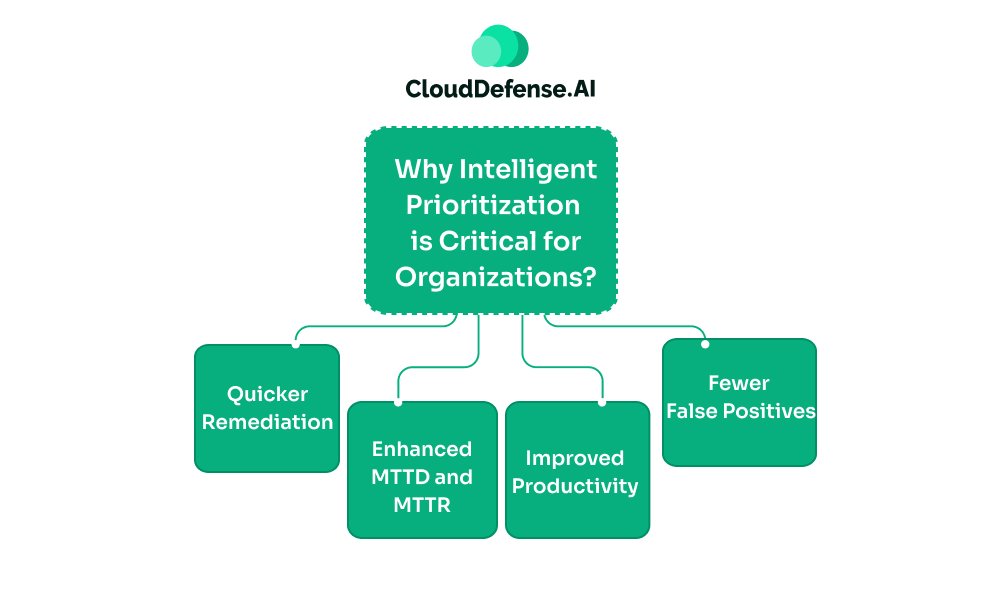
When an organization implements security prioritization with AI, it benefits them with:
- Quicker Remediation: By prioritising security alerts, developers get to identify vulnerabilities with high risk. As a result, developers can immediately patch the issue, helping with a quicker remediation process. Over time, the mean time for attackers to exploit any vulnerability has gone down to a few days. Thus, intelligent prioritisation helps developers to cope with modern cyberattacks.
- Enhanced MTTD and MTTR: When all the alerts are prioritised according to their risk level, it ensures the remediation process effort is directed to threats that matter most. A prioritised threat according to risk level allows developers to quickly respond to threats, improving overall response time. When an organization builds an effective threat prioritisation strategy, it enables them to improve the mean time to detect (MTTD) and mean time to response (MTTR).
- Improved Productivity: Not only the security team, but the development team also spends a lot of time triaging all the security alerts that come their way. However, with prioritised threat alerts, teams can carefully allocate their efforts towards the highly impactful alerts. It helps in improving the effectiveness and morale of the team while reducing the overall alert fatigue. Moreover, it prevents developers from ignoring threats that come up.
- Fewer False Positives: With risk based prioritization, organization can expect few false positives. When AI security tools prioritizes security alerts, it eliminates all the security findings that don’t pose any threat to the application. This declutters the noise in the report and helps the team to channelize the effort to the most impactful vulnerability.
The Power of AI in Intelligent Prioritization
The arrival of artificial intelligence has been a game-changer for modern application security. AI-powered security solutions address all the challenges associated with manual and complex triage processes.
It introduces an intelligent security layer in the assessment and prioritisation process, where it ingests and analyzes all the data from the organization’s infrastructure. Modern AI-based tools don’t utilise static rules or CVSS scores.
Instead, AI security tools analyze the context of the threat, historical incident data, real-time threat intelligence, and many other factors for prioritization. Based on the assessment, the tools help with security prioritisation and deliver reports with intelligently categorised threats.
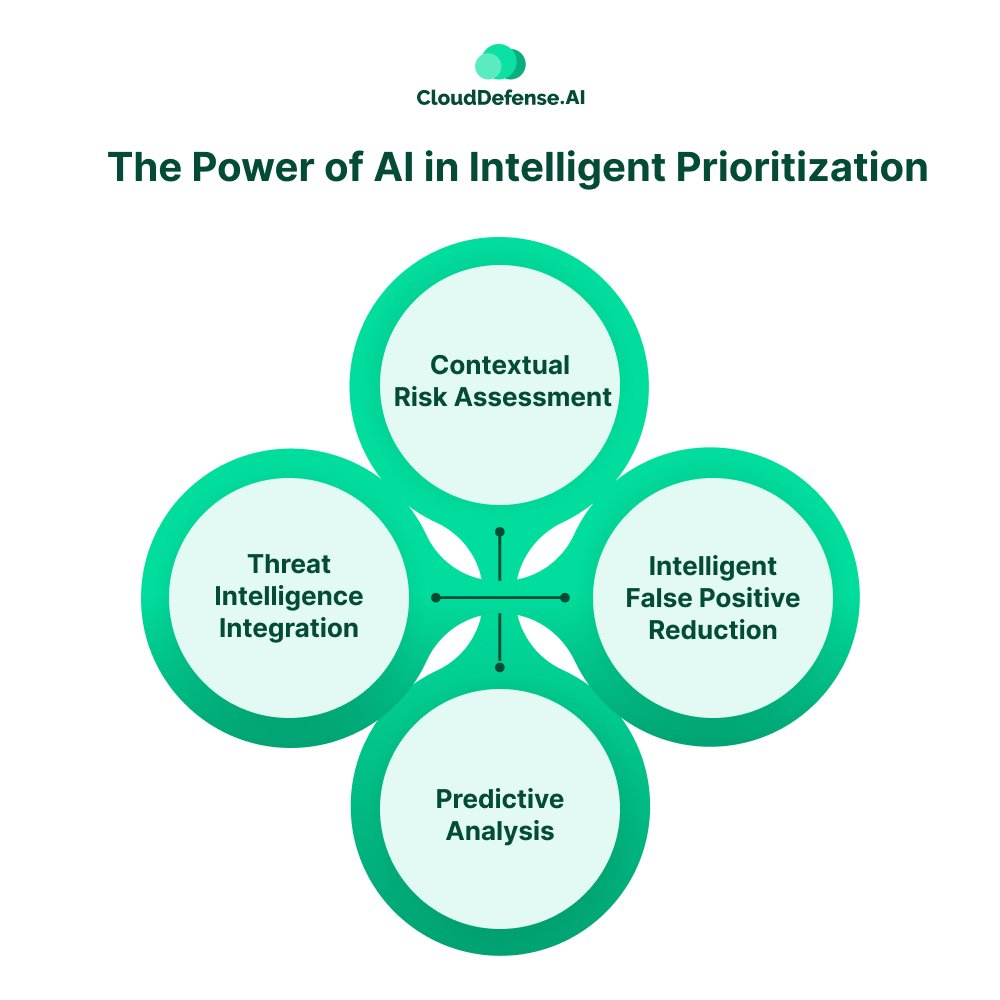
For security prioritisation with AI, security tools involve:
- Contextual Risk Assessment: In risk-based prioritization, the AI security tools perform contextual risk assessment. It goes beyond standard CVSS scores and considers all the context associated with the application. It analyzes the application’s framework, business logic, existing security policies, and many other factors. Most importantly, it analyzes the reachability of the vulnerable code to understand whether the threat is affecting the application or not. Based on the impact and reach of the vulnerable code, the tool prioritises the threat. A vulnerable code in a non-critical development environment is categorized differently from the same code on a deployed application.
- Threat Intelligence Integration: To ensure effective and accurate security prioritisation with AI, the tool integrates varied live threat intelligence feeds. It tallies all the identified threat alerts against external threat patterns, evolving attacking tactics, different modern procedures, and others. It enables the AI security tools to prioritise vulnerabilities with top priority that are actively exploited by the attackers.
- Predictive Analysis: During security prioritisation with AI, security tools also involve ML and LLM models to identify and predict which vulnerable code is likely to be exploited. The tools consider the live threat data, threat landscape of the organization, and previous patterns to predict the possibility and identify the attack path. This allows the tools to accurately prioritise the threat and enable developers to mitigate threats before they can make any impact.
- Intelligent False Positive Reduction: AI security tools, with the help of ML and AI performs automated triage. The tools correlate all the related threat data, which helps de-duplicate all the similar alerts. In the end, it filters out all the dead code and identifies which codes are false positives. Many advanced tools even utilise LLM analysis to extract the context that helps with accurately prioritising the security alerts. As a result, a lot of security alerts are reduced by a huge number, and it helps in streamlining the security prioritisation process.
QINA Pulse: A Security Co-Pilot offering Smart Prioritization
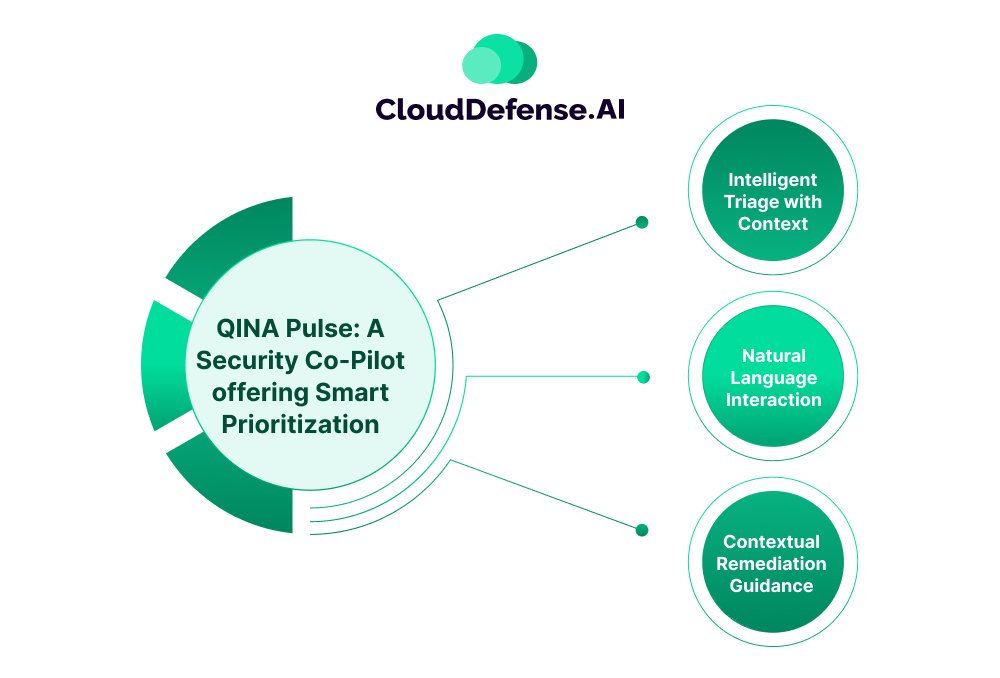
In today’s market, organizations will come across different security tools offering security prioritisation with AI. Among all, one solution that is leading the path with seamless AI-based prioritisation is QINA Pulse.
Pulse serves as an advanced and context-aware AI security co-pilot that helps with intelligent security orchestration and accurate threat prioritisation. It automatically sifts through all the security alerts to highlight all the critical threats that require immediate attention.
The development and security team can easily trigger security prioritization through simple English commands. It integrates directly into the existing AppSec and IDE to allow teams to easily interact and streamline prioritization. It addresses the traditional prioritization challenges by leveraging AI and ML.
But how does Pulse accomplish it? Here is how:
- Intelligent Triage with Context: Instead of providing a large list of identified vulnerabilities, QINA Pulse assesses all the security findings based on different contexts. It analyzes based on business goals, specific workflowintent, security policies, and infrastructure context. It helps the Pulse to eliminate all the false positives and highlight all the high-severity threats. As a result, the team gets a prioritized list with actionable insight.
- Natural Language Interaction: Pulse streamlines the security prioritization with AI through natural language interaction. The tool democratizes the security details, especially for developers, and enables them to navigate complex threat environments. It enables security analysts and developers to interact with the co-pilot in plain English. Any developer or security analyst can trigger security alert prioritization with a simple command.
- Contextual Remediation Guidance: A great aspect of Pulse is that it doesn’t just prioritise security alerts, but it also offers contextual remediation advice. The remediation guidance is provided directly into the IDE along with the prioritised reports. This allows developers to quickly address highly critical security alerts at the earliest without requiring context switching.
Final Thought
In the era where developers face thousands of security alerts, relying on manual triage and prioritization is no longer efficient. Organizations need to shift to security prioritization with AI approach that eliminates the need to triage every alert. When organizations adopt AI security tools, it prioritizes the alerts according to context and categorize them intelligently.
With risk-based prioritization through AI, organizations can shift their AppSec from reactive to proactive. When development and security teams are able to focus on what really matters, it significantly strengthens the AppSec posture. The future of cybersecurity is not about assessing all the security threats; rather about intelligently fixing imminent threats.