The modern software development lifecycle is all about achieving high-speed delivery. The speed is measured by how fast they can build, test, and deploy applications to the market. Security teams are also working alongside to ensure maximum security posture without compromising developments.
However, as every organization adopts a “shift left” approach, code security and triaging security alerts become a responsibility for developers, too. This only causes the development speed to get delayed, but it also forces developers to spend a lot of time responding to alerts.
It has created a void as organizations need to elevate beyond the shift-left approach. The need for dev-friendly security workflows that ensure a high-velocity CI/CD pipeline with optimum application security has become a need of the hour. This article highlights how an organization can build security into code flow and create dev-friendly security workflows.
Ineffectiveness of Conventional AppSec For Developers
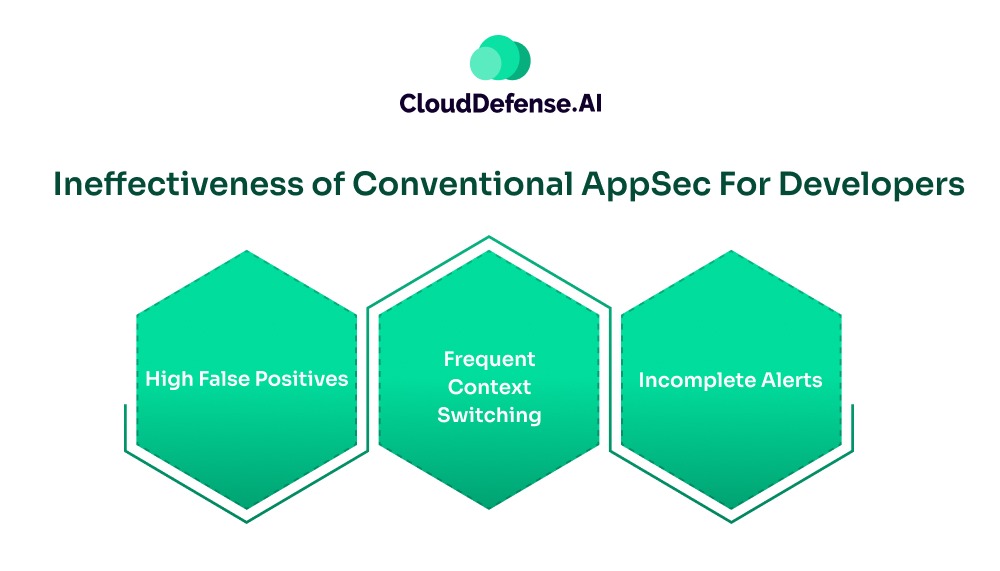
With traditional application security, the processes are not only manual, but they are time-consuming, too. Moreover, they are quite complex in operation, which makes it difficult to use for developers:
- High False Positives: Legacy AppSec tools like SAST, DAST, and SCA are designed with preset patterns and rigid rules. They lack the contextual understanding required for properly segregating security findings. As a result, a huge list of vulnerability reports is generated, where a lot of alerts are false positives. A large number of alerts not only hampers productivity but also leads to alert fatigue.
- Frequent Context Switching: Most traditional AppSec tools work in silos, forcing developers to switch from their IDE and other developer workflow tools and open a separate security dashboard. Developers are often forced to shuffle between multiple security dashboards, causing a massive disruption in the dev workflow. Moreover, each security platform comes with a unique interface and skillset, which also affects the overall productivity.
- Incomplete Alerts: All the security alerts offered by standard security tools don’t come with any deep insight. The report only comes with details about what the flaw is in the code and not how it can be solved or where it is located. The lack of actionable and contextual forces developers to invest a lot of time in researching and coming up with a solution. It ultimately creates an operational deadlock and delays the incident response time.
Building Dev-Friendly Security Workflows: The Primary Pillars
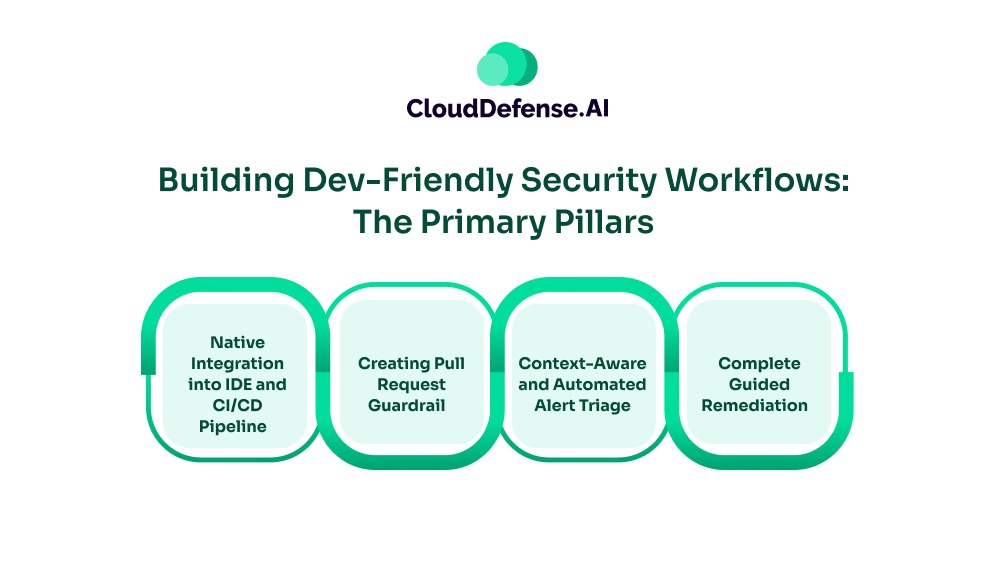
For modern organizations, creating dev-friendly security workflows has become a need of the hour. To integrate security into the code flow, organizations not only require a technical transformation but also a change in security culture.
Here is a complete blueprint for creating an integrated AppSec:
Native Integration into IDE and CI/CD Pipeline
To get started in building dev-friendly security workflows, organizations need to natively integrate AppSec tools into the development environment. An integrated AppSec into the IDE and CI/CD pipeline ensures all the security alerts and feedback are received into the development workflow.
It enables developers to seamlessly consider code security and prevent creating flaws like hardcoded credentials or involving any vulnerable library. Most importantly, it prevents developers from frequently switching context.
Creating Pull Request Guardrail
The Pull Request forms a key aspect of the development workflow. CTOs need to work on introducing automated security checks in the Pull Request. It will ensure all the code is quickly tested before it is merged, and developers are notified in case of any vulnerability.
However, enterprises need to make sure that any serious threat can flag the PR, but any low-priority threat shouldn’t prevent any merging. It is also important for security teams to ensure that the report not only highlights the vulnerable code but also highlights how the developer can remediate it.
Context-Aware and Automated Alert Triage
An important aspect of building dev-friendly security workflows is to provide developers with a smartly prioritized alert report. To achieve it, modern enterprises need to utilize AI, ML, and predictive analysis to understand the context and reachability of the flawed code.
By understanding the intent, business impact, and execution of the code, it eliminates all the dead code and false positives. It ensures that even if a code is vulnerable, but it isn’t executable by external users, it shouldn’t break the build. Thus, it enables developers to focus on flawed code that will impact the business.
Complete Guided Remediation
Developers aren’t supposed to have a deep knowledge of code security. Thus, when a vulnerable code is reported without any remediation guidance, it becomes difficult for the developer to solve it.
Dev-friendly security workflows demand integrated AppSec tools to provide insightful reports with complete remediation guidance. When the security scanners provide an alert report with a contextual patch process, it becomes seamless for developers to fix the threat without sacrificing productivity.
Perks of Adopting Developer-Friendly Security Workflows
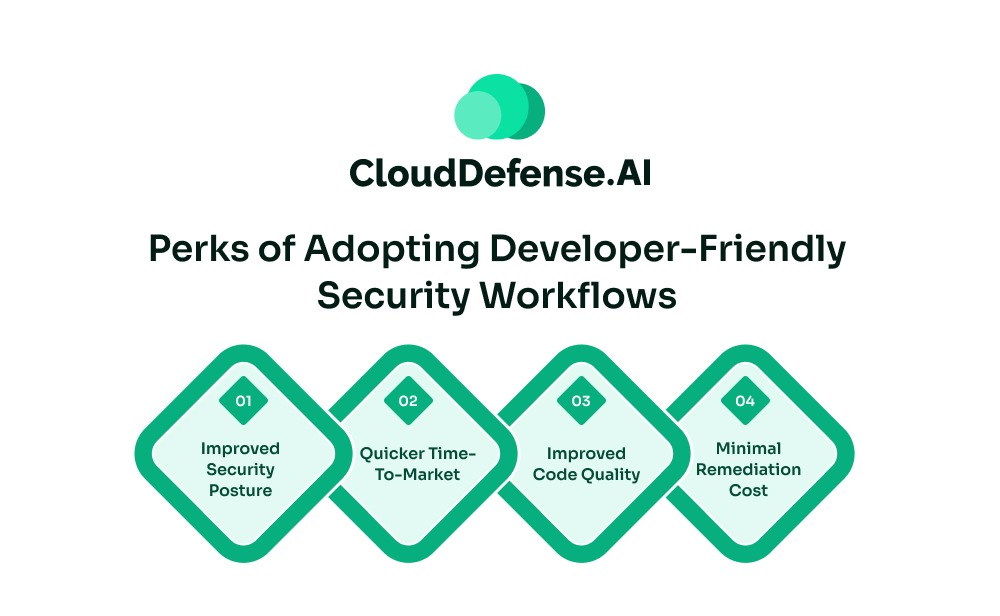
When security is integrated into the development workflow, it benefits the developers in many ways:
- Improved Security Posture: An integrated AppSec into the development workflow helps developers to catch vulnerabilities at the earliest. It not only reduces the chance of data breaches but also improves the shift-left approach.
- Quicker Time-To-Market: With minimal bottlenecks and automated code assessment before code is committed, developers are able to improve their productivity. This helps in achieving faster time-to-market.
- Improved Code Quality: A dev-friendly security workflows ensures developers are responsible for the security of all the code they commit. A secure code makes sure not only that the code quality is high, but the overall application quality is also reliable.
- Minimal Remediation Cost: Since most of the vulnerabilities are identified and remediated in the development stage, it minimizes the remediation cost. A flawed code is much easier and cheaper to fix during development rather than in the deployed stage.
Streamlining Security Workflow With QINA Pulse
Achieving dev-friendly security workflows requires organizations to implement the right tools and technology that bridge the gap between developers and AppSec. QINA Pulse is helping enterprises to minimize all the friction by serving as an AI security co-pilot. It serves as an intelligent security assistant that enables developers to perform different security tasks with ease.
It is designed in such a way that it can natively integrate with numerous enterprise-grade development tools like Jenkins, GitHub, and many more. It fits in the existing CI/CD pipeline and helps the developers to orchestrate any task. Pulse automates all the complex security tasks through simple English, eliminating friction between developers and AppSec.
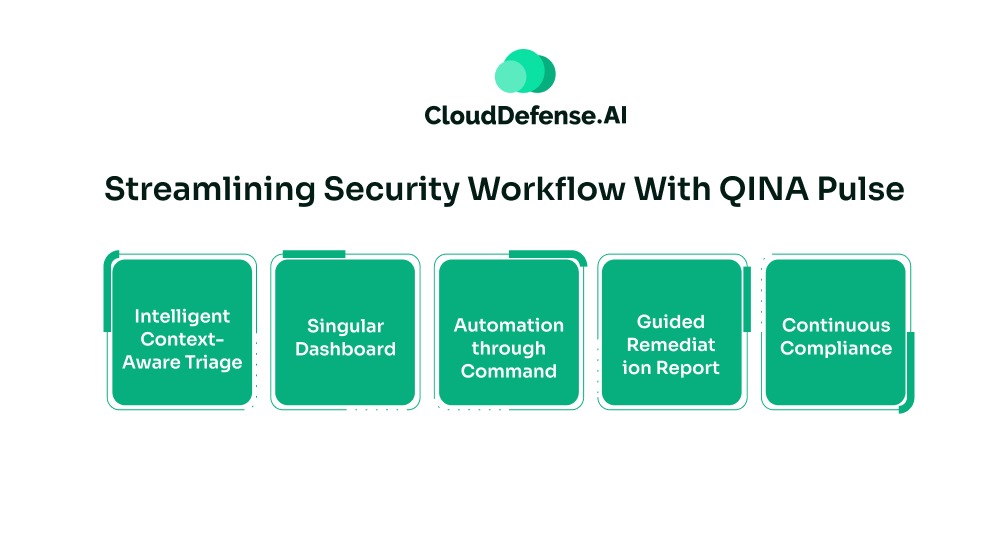
Here are key features of QINA Pulse that empower developers to build dev-friendly security workflows:
- Intelligent Context-Aware Triage: QINA Pulse is built on advanced AI and ML that intelligently prioritizes security alerts. It eliminates all the dead code and performs contextual analysis to provide developers with smartly prioritized alert reports. It also eliminates all the false positives, ensuring developers spend time on actual threats.
- Singular Dashboard: When an enterprise integrates Pulse, it provides developers with a single dashboard that they can access from the IDE and CI/CD pipeline. This integrated AppSec tool enables both developers and security professionals to associate and work collaboratively on their AppSec strategy.
- Automation through Command: With Pulse, developers don’t require any deep cybersecurity knowledge when automating complex workflows. Through simple English commands, devs can generate compliance reports or run scans with ease.
- Guided Remediation Report: This security assistant doesn’t provide generic remediation guidance; instead, it offers contextual remediation processes with code snippets. It points out where the vulnerable code is located and helps in automating the code fix process.
- Continuous Compliance: QINA Pulse continuously maps all the changes as the application code evolves with time. Since it ingests all the security findings, it enables the developers to create audit-ready reports within minutes. It helps enterprises to maintain compliance with regulatory standards without sacrificing development speed.
Bottom Line
Building security into the code flow has become a necessity for all enterprises that want to create a secure and robust application. Dev-friendly security workflows serve as an efficient approach that enables developers to create applications without sacrificing code security.
For modern enterprises, QINA Pulse is coming up as a plausible solution that is enabling enterprises to secure the code and accelerate delivery at the same time. With Pulse, organizations no longer have to choose between delivering fast and staying secure. It creates a collaborative environment where code security becomes a shared responsibility for developers.