
In modern DevSecOps, the major bottleneck in today’s high-speed development approach isn’t just the slow scanning process but also the heaps of alerts generated during scans. Every time a SAST, DAST, or SCA finishes its scanning process, it dumps hundreds of security findings, which are then sent to developers as alerts.
However, for teams, the problem isn’t with the security findings but triaging them manually. This creates a serious gap between threat identification and remediation. Furthermore, it becomes a hurdle for teams to maintain high velocity delivery without sacrificing security. For enterprises, automating vulnerability triage serves as the strategic approach to all bottlenecks.
To implement this approach, QINA Pulse has emerged as a plausible choice. It helps teams to move away from manual triage and transform all the raw security findings into a contextual and prioritized Jira ticket. In this article, we are going to explore the workflow of vulnerability triage automation, why it has become a necessity, and how QINA Pulse helps in implementing it.
Vulnerability Triage Automation: An Automated Workflow
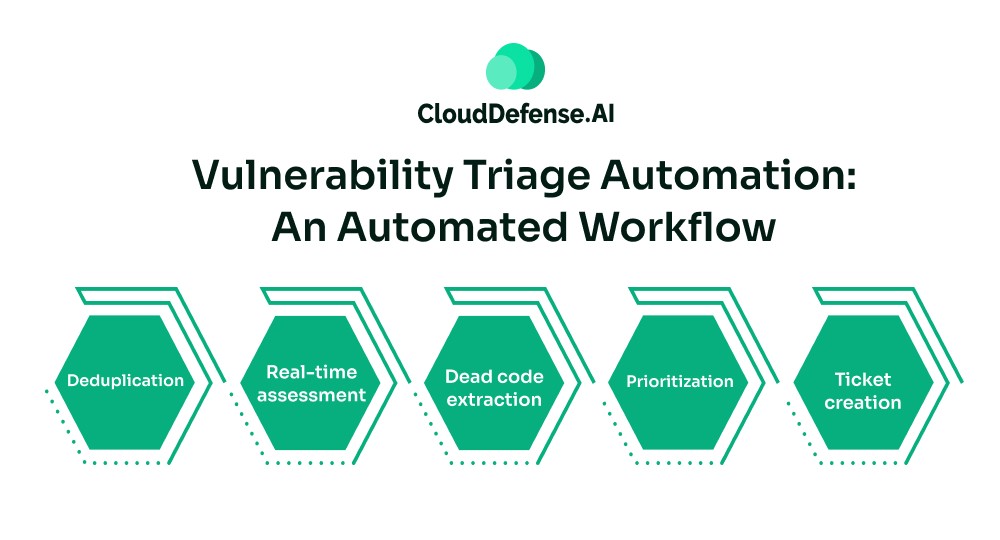
Vulnerability triage automation is an automated approach that leverages AI or workflow orchestration systems to automate the triaging workflow. The process involves automated security finding analysis, classification, prioritisation, and automated ticket creation at the end.
It enables organizations to move from an intensive manual triage process, taking hours to days, to an intelligent classification process. For a small team, managing a few sets of reports is still manageable. However, for enterprises, manually triaging hundreds and often thousands of security findings every day is a nightmare. Vulnerability triage automation typically involves:
- Deduplication: It analyses all the security findings and identifies and eliminates all the duplicate findings across all the scanners.
- Real-time assessment: It evaluates all the findings based on CVSS score, exploit availability, real-time vulnerability streams, and contextual aspects.
- Dead code extraction: Some tools perform reachability analysis and code execution to extract all the dead code from the security finding reports.
- Prioritization: All the security findings are prioritized based on security, business context, the developer’s intent, and various other aspects.
- Ticket creation- Ultimately, tickets are generated through tools like Jira and sent directly to the team along with remediation support.
It ensures a comprehensive vulnerability management automation that allows teams to quickly respond to vulnerabilities without compromising on development.
Why Manual Triage Fails in Modern DevSecOps
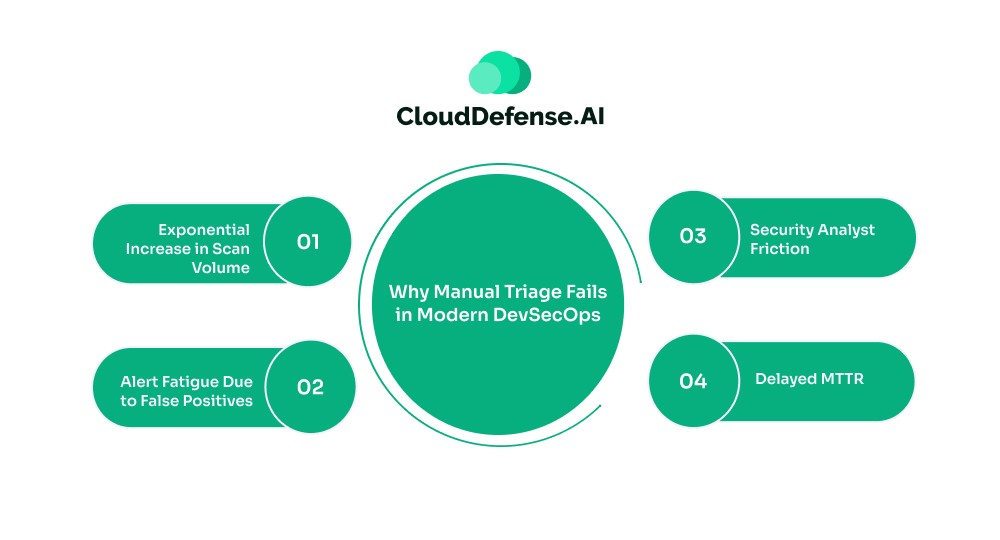
In the modern AppSec workflow, manual triaging is no longer efficient. Typically, a single scan generates hundreds of security findings, and teams have to manually triage to determine their exploitability in context to the application.
The major issues with manual triage are:
- Exponential Increase in Scan Volume: Modern applications are built on microservices, libraries, third-party dependencies, and containers. With time, the number of dependencies is also increasing, and so does the attack surface. As a result, a huge number of alerts are generated daily, making it excruciating for teams to assess all the security findings.
- Alert Fatigue Due to False Positives: A lot of security findings are generated by traditional scanners, most of which are false positives. Overwhelmed by a significant amount of false positives, teams develop alert fatigue, which leads to degradation in triaging quality. This factor leads to alert fatigue, causing teams to overlook true positive alerts.
- Security Analyst Friction: The global security professional shortage is an evident fact, making every professional a vital resource. Organizations utilizing manual triaging have to ask their cybersecurity team to spend time routing security findings into Jira tickets. This not only diverts them from productive cybersecurity tasks but also causes fatigue.
- Delayed MTTR: Triaging all the security findings manually and researching plausible solutions for all the true positive findings is a time-consuming process. This leads to a delay in responding to critical security alerts. Many studies have shown that most high-impact vulnerabilities with public exploits are utilized within a few days, leading to a serious threat to the overall AppSec posture.
QINA Pulse: Automating Scan to Jira Ticket Workflow
Vulnerability triage automation has become a need of the hour for organizations. Most enterprises are rapidly shifting to automated tools that will bring complete automation from scanning to Jira ticket generation.
Among all, QINA Pulse has emerged as the top choice that acts as a smart orchestration layer between the security scanners and project management platforms like Jira. This security assistant is designed to ingest data across all the scanners, understand them, create a prioritized report, and generate alerts.
It leverages contextual analysis, deduplication, and intelligent risk scoring to convert all the raw findings into actionable intelligence. Importantly, it natively integrates with a number of AppSec platforms and utilizes AI along with ML and LLMs to implement vulnerability triage automation at machine speed.
How QINA Pulse Performs Vulnerability Triage Automation
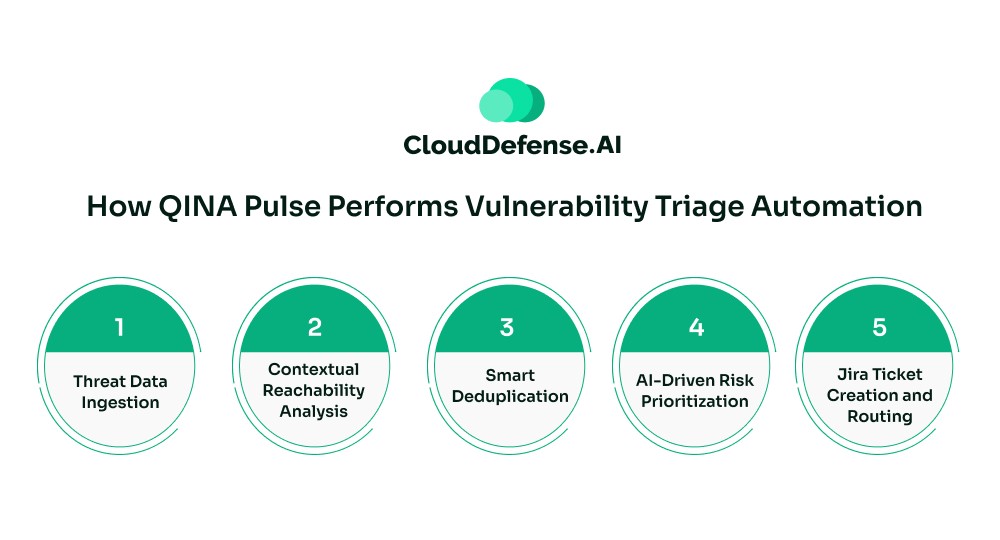
The true ability of QINA Pulse lies in its ability to automate the complete workflow. Here is how Pulse automates the Scan to Jira workflow:
- Threat Data Ingestion: QINA Pulse is designed to integrate seamlessly with numerous AppSec tools like SAST, DAST, CSPM, and others. It enables the security co-pilot to ingest across all the tools and convert them into a comprehensive vulnerability schema.
- Contextual Reachability Analysis: Pulse doesn’t just forward the findings directly into the IDE. It performs a contextual reachability analysis based on the application’s architecture, business context, and the developer’s intent. Even if a vulnerable library is associated with a specific function, but that specific function can’t be triggered in production, then Pulse prioritises it. Based on the analysis, it eliminates all the dead code, which ultimately helps in removing all the false positives.
- Smart Deduplication: Different scanners often come up with the same vulnerability when scanning the same codebase. These duplicate findings not only add to the volume but also lead to fatigue during the triaging process. Pulse utilizes an efficient deduplication process to consolidate all similar vulnerabilities into a single consolidated finding and prevent a backlog in the triaging process.
- AI-Driven Risk Prioritization: After ingesting all the security findings, QINA Pulse utilizes a proprietary risk prioritization for the vulnerability triage automation. Instead of prioritizing the alerts based on CVSS or other vulnerability databases, it understands the context of all the alerts. Pulse makes use of LLM models to evaluate the attack vector along with the exploitability, which ultimately helps in intelligently prioritizing the risks. Based on the LLM analysis, it categorises the vulnerabilities based on criticality, business impact, and reachability.
- Jira Ticket Creation and Routing: Pulse integrates natively with Jira through its one-click integration. Then it generates a structured Jira ticket comprising affected code snippets, severity rating, a complete remediation guide, and SLA deadline. Through its vulnerability triage automation workflow, the reports are directly routed to the developer’s workflow. This streamlines the whole remediation process as developers won’t have to go back and forth to apply the fix.
Major ROI from Vulnerability Management Automation
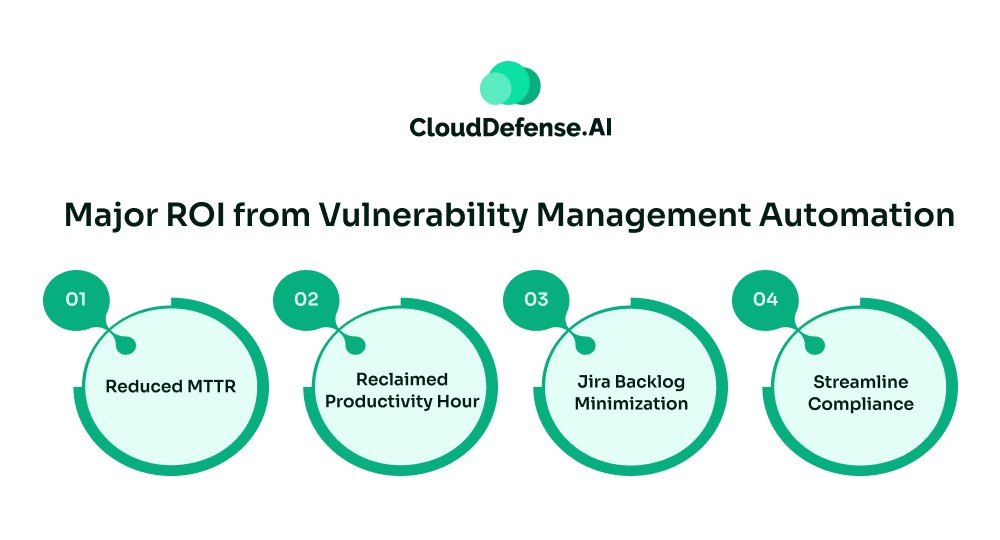
When an enterprise implements vulnerability management automation through tools like QINA Pulse, they can expect several measurable ROI:
- Reduced MTTR: Prioritized alert and precise remediation guidance through Jira tickets enables teams to quickly fix any vulnerabilities as they originate. In many cases, Pulse can also automate fixes for common types of vulnerabilities. Ultimately, teams are able to bring MTTR from days to a few minutes.
- Reclaimed Productivity Hour: Eliminating all the bottlenecks in the triaging workflow and minimizing context switching, teams are able to focus on their productive tasks. Previously, both the development and security teams spent a lot of hours on manual triage and ticket generation. But modern vulnerability triage automation completely eliminates it.
- Jira Backlog Minimization: QINA Pulse significantly reduces backlogs by deduplication and intelligent reachability analysis. It ensures that no unreachable and unexploitable security findings ever enter the Jira ticketing system.
- Streamline Compliance: Pulse helps in creating automated triage records, SBOMs, and continuous compliance reports based on the automated scans. This helps in creating a complete audit trail, making the enterprise completely audit-ready and free from compliance risk.
Bottom Line
For all enterprises, vulnerability triage automation is no longer a goal but has become an important aspect to maintain an optimum AppSec posture. With time, applications are leveraging numerous services and dependencies, leading to an increase in the volume of security findings.
The manual approach is no longer sufficient. Success in modern times requires an agentic approach where automation will take care of the triaging process. QINA Pulse represents an advanced and integrated tool that can seamlessly automate the workflow from scan to Jira tickets. It helps the team to utilize the true power of DevSecOps and ensure high-speed application delivery at scale without compromising on security.