In today’s high-stakes healthcare sector, where healthcare providers leverage various digital solutions, health security has become paramount. Healthcare cybersecurity is always under pressure from data breaches or zero-day exploits, as it holds millions of patients’ data. However, the most severe issue that has plagued the industry is False Positives.
Due to the use of traditional or contextless application security tools, security teams are plagued by thousands of security alerts, most of which are false positives. The false alarms are not just noise to security teams; they are a major roadblock to maintaining optimum healthcare security.
Over the years, the impact of high false positives has drained security teams, causing them to overlook numerous real attacks. In an industry where a delay in security response can lead to breaches, healthcare providers require context-aware AppSec.
This article will explore the devastating impact of high false positives in healthcare security and how healthcare providers can mitigate them.
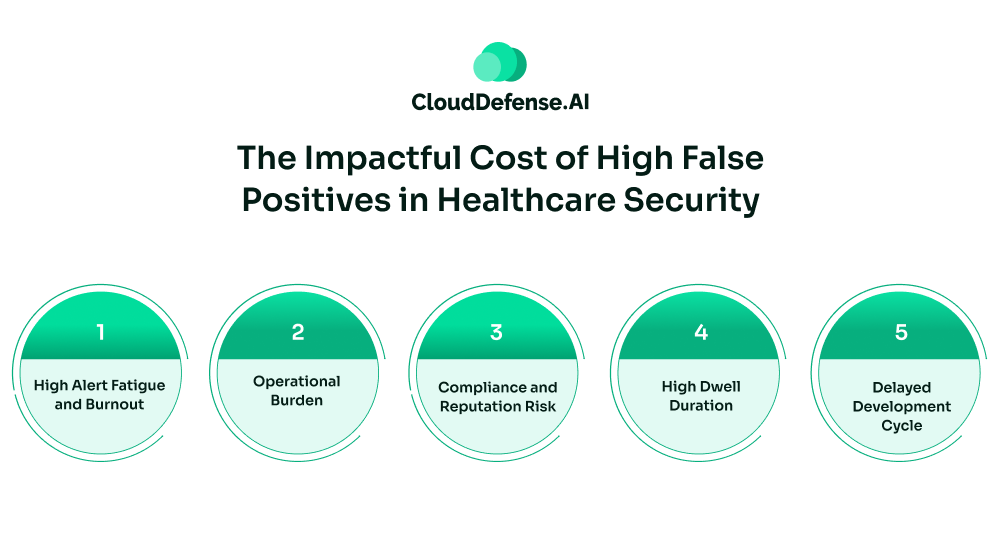
The Impactful Cost of High False Positives in Healthcare Security
The modern healthcare ecosystem comprises numerous interconnected systems involving ER, lab systems, medical devices, and proprietary medical apps.
Security tools safeguarding the healthcare ecosystem generate a lot of security alerts, most of which are false positives. A false positive- a benign security activity that is identified as a security vulnerability by AppSec tools.
It may seem like a noise, but it has a crippling impact on healthcare security:
High Alert Fatigue and Burnout
Every day, security teams in healthcare institutions receive thousands of security and clinical alerts from various tools. However, most of them turn out to be false positives, causing high alert fatigue among professionals.
Since most professionals utilise a manual triage process, the real threats get stranded in the queue, causing slowed response time. Critical alerts also get dismissed due to desensitization. As a result, many data breaches and real patients are harmed due to overlooking real alerts.
Operational Burden
In the healthcare industry, false positives can disrupt a healthcare operation. For security analysts, they have to direct all the resources for manually triaging the security alert- assessing every aspect- only to find out it is a false positive. An ongoing triaging can interrupt the operation of all the interconnected systems in the digital system, which include EHRs and diagnostics.
The investigation might also quarantine a connected medical device, which can either slow down an ongoing patient or impact the patient’s safety. Frequent interruption in the medical workflow can also cause friction among security and medical professionals.
Compliance and Reputation Risk
Every healthcare provider has to adhere to HIPAA and other industry regulations as they mandate the protection of health information. However, while investigating the false positives, the security teams have to direct most resources towards it, delaying response to real threats.
It not only diverts the team from actual threat hunting but also makes healthcare security prone to breaches. So when a security breach occurs in EHR application security or overall healthcare AppSec, it leads to reputational risk. Most importantly, it also causes violations in HIPAA compliance, leading to fines.
High Dwell Duration
When security analysts in healthcare AppSec are busy triaging false positives- delaying incident response, attackers exploit this situation. In many cases, security professionals lower the sensitivity or overlook the noisy AppSec tool.
It gives attackers the opportunity to enter the healthcare system and remain inside for a limited time undetected. It not only makes the healthcare equipment vulnerable but also allows leakage of the patient’s health information.
Delayed Development Cycle
Modern healthcare institutions are highly dependent on different healthcare applications, like patient portals or telemedicine, to perform different operations. As a result, these applications require constant app support.
When the tools used in healthcare AppSec generate false positives by falsely flagging benign code, it forces the developers to perform triage and fix it. As a result, the whole development team has to direct their resources towards the fixing process, causing a delay in the feature rollout.
How Organizations Can Minimize High False Positives in Healthcare Security?
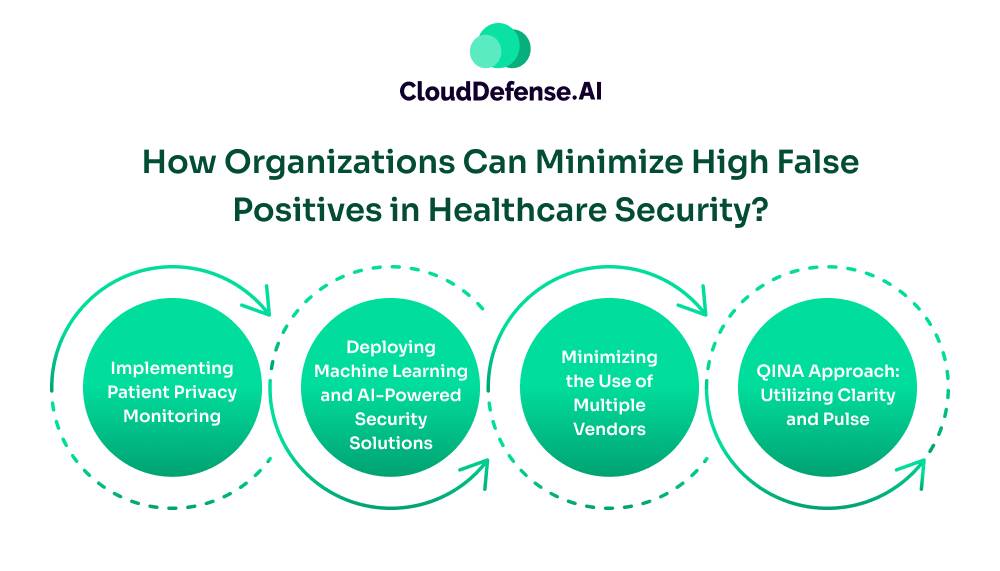
When it comes to minimizing the impact of high false positives in healthcare security, a healthcare provider can take different approaches. Some of these approaches are:
Implementing Patient Privacy Monitoring
It is known to everyone, no approach can help a healthcare AppSec team to completely false positives. Healthcare institutes, through a strategized approach, can aim for SAST noise reduction.
One way to achieve it is by deploying a patient privacy monitoring system that will natively integrate with the EHR environment. The system will constantly monitor the EHR to detect and eliminate the maximum amount of false positives from the alert pipeline.
A patient privacy monitoring platform with features like behavioural correlation can significantly filter out false positives by almost 40%. It will not only help in filtering out repeated alerts but also business-based warnings. It will enable the security analysts to work on security findings that are real.
Deploying Machine Learning and AI-Powered Security Solutions
Another way to reduce high false positive issues in cybersecurity is by deploying healthcare tools based on AI and machine learning. AI-based SAST tools can also help with AppSec healthcare scanning as they are equipped with context-aware scanning and reachability analysis capabilities.
An AI-powered solution can understand the context of the health tech application and how it operates, reducing the chance of false flagging codes. Machine learning, on the other hand, will ingest all the healthcare data and mimic the behavior of healthcare security analysts.
In this way, it will understand which security alerts are false positives and which security alert requires immediate investigation. Moreover, the cyberthreats are continuously evolving, so the tools should be updated and fine-tuned at regular intervals.
Minimizing the Use of Multiple Vendors
Many healthcare institutes integrate multiple healthcare AppSec vendors to ensure optimum healthcare security and protect patients’ information. According to the Cisco CISO benchmark study in 2019, it is observed that a large number of organizations implement more than 20 vendors for a single task.
However, adopting too many vendors for just patient privacy monitoring solutions can lead to too many alerts, mostly false positives. Healthcare providers with a minimal number of vendors and an architectural approach can effectively manage high false positive issues.
A single vendor offering complete management of healthcare data security and integrating all the services in a single dashboard will be an ideal choice.
What if a healthcare provider can go beyond all the above solutions and implement a single and robust solution to minimize the impact of a high false positive rate? The best solution for it is:
QINA Approach: Utilizing Clarity and Pulse
A high false positive rate has a crippling effect on modern EHR application security, and to combat healthcare needs to move beyond the rule-based approach.
QINA Clarity and Pulse provide the ecosystem that minimizes false positives and enables security analysts to focus on real threats.
QINA Clarity: AI-Powered Security Analyst
QINA Clarity from CloudDefense.AI is the next-generation AI-backed SAST engine that is designed to power modern healthcare AppSec. It goes beyond pattern scanning and understands every context to present actual threats. This AI-SAST eliminates high false positives by:
- 4-Stage Analysis: QINA Clarity utilizes a specialized 4-stage analysis where it first detects the dead code through reachability analysis. Then extract context from the reachable finding and perform LLM reasoning with business logic awareness. At the end, it intelligently classified to filter out false positives and highlight which alerts are must-fix.
- ML and Deep Learning: The tool utilizes LLMs and deep learning to understand the intent and flow of code. This helps in eliminating many repetitive and unnecessary security findings, allowing security teams to focus on high-risk vulnerabilities.
- Native Integration: Clarity AI integrates natively into the healthcare AppSec and rapidly scans for threats. It not only prevents security bottlenecks for healthcare updates but also prevents false alarms.
QINA Pulse: Ingellient Security Co-Pilot
While QINA Clarity helps with security scanning and cleaning noise, QINA Pulse provides active and real-time security intelligence. It integrates into the EHR application security and enables developers to perform and automate healthcare security with ease. By acting as an intelligent co-pilot, it also helps in noise reduction by:
- Report Generation: It enables developers to pull reports within a few seconds. The report provides detailed insight into healthcare AppSec security findings and enables developers to get the required information that helps with triaging.
- Evidence Correlation: QINA Pulse helps ingest all the evidence by connecting across all the security. It performs real-time data aggregation and correlates the findings from Clarity with runtime data. When developers write a command to eliminate false positives, they analyze the execution path of the security findings. If there is no traffic, it immediately downgrades the severity level. It also helps with audit-ready reporting, which helps with compliance maintenance.
- Smart Prioritization: This AI assistant also helps in minimizing high false positives through smart prioritization. It not only performs business impact analysis but also visualizes the attack surface to decide the severity level of the code.
Bottom Line
In healthcare AppSec, more alerts don’t mean better security. A large amount of security often comes in the form of false positives. A high false positive rate has a severe impact on healthcare security. It can compromise the whole medical operation and put patient health at risk.
It not only makes the interconnected medical devices prone to attack but also delays the response to vulnerabilities that can cause patient information theft. A comprehensive approach through QINA Clarity and Pulse can enable healthcare providers to minimize high false positives by a large margin.
It serves as an all-in-one solution that provides the analyst a single dashboard and security assistant to shift to context-aware healthcare security. It helps in reducing false positives and enables security analysts to focus on alerts that can impact a patient’s safety and health. Want to see QINA Pulse and Clarity in action? Book the free demo now.